


This article is co-published with High Country News.
In March 2025, news trickled out through Internet forums that the Utah Legislature might double the price of non-resident hunting permits. This would have made Utah one of the most expensive states for nonresidents to hunt big game, fueling hunter’s frustration as their sport evolves from a working-class birthright to a luxury for the rich.
The fee hike caught hunters by surprise. Utah’s Department of Wildlife Resources, or DWR, normally raises permit fees through a lengthy process that requires multiple public meetings around the state. This time, the state’s Republican-dominated Legislature buried the changes over 100 pages deep in an agency-funding bill. Hunting fees help pay for wildlife habitat preservation through the much-touted North American Model of Wildlife Conservation. But the hunter-backed wildlife groups that normally champion such measures said nothing, and the DWR did not issue a public statement about the changes until after Gov. Spencer Cox, R, signed the bill into law.
Behind the scenes, however, state Rep. Casey Snider, R-Paradise, was working with wildlife agency leaders to raise money to purchase tens of thousands of game-rich acres from a separate state agency. It was the culmination of a series of moves that Snider, a public-land hunting champion, had made in recent years to shield some of the state’s finest hunting lands from development or sell-off.
In order to do so, however, Snider and his allies at the agency — including former legislator and current Department of Natural Resources Director Joel Ferry — avoided publicizing their efforts. The group was eyeing parcels owned by the Utah Trust Lands Administration, or TLA, formerly known as the School and Institutional Trust Lands Administration, or SITLA. The agency has historically allowed public hunting access on most of its holdings, but that activity doesn’t raise significant revenue. And unlike most public lands, state trust lands have a mandate to maximize their economic potential in order to fund the public school system. When trust lands are put up for sale, state law requires the agency to take the highest bid.
The state Legislature has not historically authorized the funds for wildlife officials to make a timely bid when the Trust Lands Administration offers land for sale, certainly not enough to win a bidding war. Depending on the parcel, several entities might be interested — real estate developers, oil and gas companies, mineral extractors. But Snider and his allies hoped to head off one potential buyer in particular: The Ute Indian Tribe.
The Uintah and Ouray Reservation at one point comprised 4 million acres in northwest Utah. But the imposition of “allotment,” a federal requirement to sell tribal land to individual settlers beginning in the late 19th century, left the reservation checkerboarded. Then, in 1905, President Theodore Roosevelt commandeered more than 1 million acres of that land to create what became Ashley National Forest. In turn, Utah ultimately took some of that pilfered territory and enrolled it as state trust land. Today, the trust lands agency controls half a million acres within the reservation’s boundaries, and tribal members must pay tens of thousands of dollars annually in grazing permits to use it.
But the Ute Tribe wants its ancestral lands back. It has tried to buy trust land at auction in the past and is currently suing the Department of Interior for the return of 1.5 million acres. After finding out about the quiet land deals, the Ute Tribe re-filed a long-standing lawsuit in November, accusing Utah officials of fraudulently manipulating trust-land sales with “racial animus” to prevent the tribe from winning open bids.
The Ute Tribe declined repeatedly through its lawyer, Linda Cooper, to comment on this story.
Last month, the Trust Land Administration’s board of trustees authorized a no-bid sale of the most coveted block of land, a 50,000-acre roadless portion of the Book Cliffs, to the Department of Natural Resources, DWR’s parent agency — despite the fact that the tribe has challenged the legislation authorizing the sale in court. Though the DWR wants the land to conserve it for wildlife instead of exploiting it for oil and gas, the Trust Lands Administration will retain the mineral rights. And the wildlife agency plans to buy up more parcels in the near future.
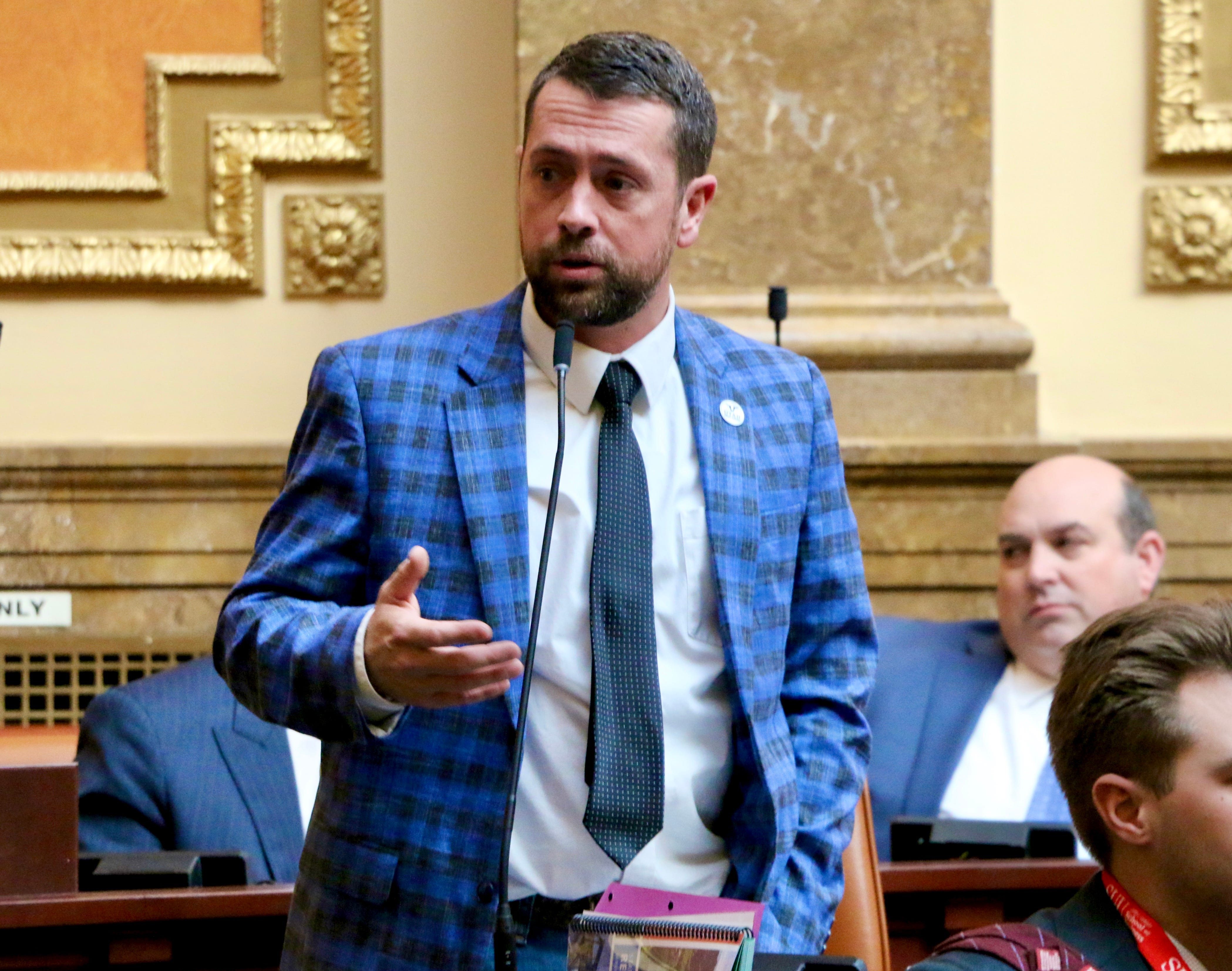
CASEY SNIDER, 40, HAS PUSHED a hunter-first agenda since joining the Utah Legislature in 2019, spearheading the campaign to establish a state constitutional right to hunt and fish the following year. He authored a law that required people to buy a state hunting or fishing license in order to recreate on Wildlife Management Areas last year, which drew sharp backlash and an eventual revision after game wardens threatened to ticket confused birders and trail runners.
In a state where the Republican Party has declared war on federal public-land ownership — a policy that critics see as a Trojan horse for privatization — Snider still sees public land as a democratic inheritance that keeps the hunting tradition alive by preserving habitat for dwindling big game populations and giving hunters a place to pursue them. “Opportunities are more and more limited,” Snider said in an interview last year. “It’s more and more crowded. I just think we should prioritize hunting and fishing whenever we can.”
Trust lands pose a major challenge for public-land hunting defenders like Snider. For more than a century, wildlife officials have preserved hunting access to these lands, some of which are among the state’s most pristine, enjoyed by backpackers, horsepackers and backcountry anglers as well as hunters. But the land agency’s first obligation is to fund Utah’s schools. If it decides it can get a better return by leasing mineral rights to drill for oil or selling the surface rights to another owner, then that’s what its mission requires it to do.
Still, with public-land hunters a major constituency in Utah, the agency also faces pressure to preserve existing hunting access to its lands.
It felt the wrath of public-land hunters in 2018, when it tried to sell a parcel that included Tabby Mountain, a cherished public hunting area in northeastern Utah. The block generated little money for the Trust Lands Administration, so the agency agreed to auction it, with the understanding that Wildlife Resources would scoop it up as the sole interested buyer.
But Tabby Mountain, which is named for the late Ute Chief Tabby-To-Kwanah, lies squarely within the Uintah and Ouray Indian Reservation’s historic boundaries. When the trust lands agency put the block up for sale, the Ute Tribe outbid the wildlife agency to buy it back.
The Ute Tribe stood on the verge of reacquiring a historic hunting ground and a mountain that tribal members regard as sacred. But the outcome would have been a disaster for the wildlife officials, who had tried to disguise a frictionless inter-agency land transfer as a public auction. The Ute Tribe does not allow non-tribal members to hunt on tribal land.
A week after the auction, the land agency’s board voted to suspend the sale of Tabby Mountain. In 2022, the Ute Tribe sued Utah officials in federal court for discrimination, fraud and breaching its trust obligations to school children after a whistleblower came forward alleging that it had deliberately blocked the sale to keep Tabby Mountain from falling back into Ute hands.
“It’s bad enough that the tribe has to spend millions of dollars just to buy back its own land,” Shaun Chapoose, then-chairman of the Ute Indian Tribe Business Committee, told ICT at the time. “But what really grates is the deceit and treachery with which the state has acted in order to block the sale from going through to the tribe, as the highest bidder.”
SNIDER WAS STILL JUST A junior legislator back when the agency nearly auctioned Tabby Mountain back to the Ute Tribe, but preserving hunter access to trust land would become one of his signature issues. When the Trust Lands Administration put up another prized block of hunting land called Cinnamon Creek for sale a few years later, Snider went on a mad dash to convince the Legislature to fork over the money for Wildlife Resources to buy it.
Buoyed by a swell of sympathetic publicity and financial contributions from conservation groups and the U.S. Fish and Wildlife Service, the DWR placed a winning bid and acquired the parcel. But the experience highlighted glaring problems that pretty much guaranteed that it would find itself in that situation again. Wildlife officials lacked a standing budget to buy land, and in Utah, where the Legislature meets once a year for just 45 days, it’s almost always impossible to raise cash for a public agency quickly.
Over the next several sessions, Snider tried to change that. He established a small land-buying fund for the wildlife agency, then, in 2024, spearheaded a bill that allowed the Trust Lands Administration to sell parcels larger than 5,000 acres directly to the DWR for fair market value. The bill drew sharp criticism from the Ute Tribe Business Committee, which saw the law as an attempt to prevent it from buying back ancestral land now owned by the state.
Snider played down those concerns at the time, noting that the law, which passed that year, specifically exempted Tabby Mountain. But Snider had a long history with another large trust land block bordering Ute land.
The Book Cliffs Roadless Area is a roughly 50,000-acre stretch of rugged mountain country nestled in the state’s northeastern corner. Save for a few grazing permits, the area remains untouched by industry. It holds one of the country’s few herds of wild, unfenced buffalo, along with some of Utah’s largest elk and mule deer, and a blue-ribbon native trout fishery.
It also holds oil. In 2013, the trust lands board voted to lease the Book Cliffs Roadless Area for petroleum development. The prospect of drilling the remote wilderness drew such a backlash from hunters and anglers that then-Gov. Gary Herbert stepped in to suspend the lease. Snider, then serving as the state coordinator for Trout Unlimited, was among its most prominent opponents.
By the beginning of the 2025 legislative session, Snider had figured out a way to buy the land. The only thing he needed was the money.
SNIDER RAISED THE MONEY FOR the Book Cliffs and several other Lands Administration parcels quietly, in two ways. First, he gave Wildlife Resources the authority to double the cost of non-resident hunting permits. Raising the price of hunting tags isn’t unusual, but Snider’s approach was. Such proposals traditionally come from the wildlife agency, rather than the Legislature. The proposal is then presented for a lengthy and tediously democratic series of discussions at the agency’s Regional Advisory Committee meetings, where stakeholders have several months to weigh in on the issue. Big changes like fee hikes usually find their way into the hook-and-bullet press, which draws even more attention.
Instead, Snider inserted a clause into the agency appropriations budget that gave the agency the authority to, at its discretion, raise non-resident hunting fees up to double their current cost. The agency said nothing about the fee hikes until they had already become law, then hiked fees for out-of-staters by roughly 40% across the board. (The Department of Wildlife Resources said in an email that it had stayed quiet because it does not comment on pending legislation.)
Overnight, Utah’s non-resident permits went from being some of the most affordable in the West to some of the most expensive. The only state where a non-resident might pay prices topping Utah’s for premium mule deer ($1,079), elk ($1,950) and bighorn sheep ($3,998) permits is Wyoming, which conducts a “special draw” that gives deep-pocketed applicants a higher chance of pulling scarce tags. Wildlife Resources Director Riley Peck defended the price increases at the time in a press release, saying they fell in line with “relevant market values of neighboring states” — a comment eliding the fact that the U.S. system of distributing permits through state agencies was invented precisely to eliminate market pressure on wildlife.
It’s easy for politicians to beat up on out-of-staters who don’t vote in Utah. Snider had to tread even more lightly, however, when it came to raising the money for the Book Cliffs last year. Again he turned to the appropriations process rather than filing standalone legislation. This time he asked legislators to hand the agency a whopping one-time payment of $50 million to buy unspecified tracts of state trust land to preserve hunting access. The funds ultimately came out of the education budget.
The measure invited little discussion when Utah Fiscal Analyst Jonathan Ball presented it to the Executive Appropriations Committee at a Feb. 28 meeting last year. The only committee member to oppose it was Sen. Kathleen Riebe, a Salt Lake City Democrat, who hadn’t even heard about the land purchases until that day. She asked environmental groups she knew for more information about the proposal, only to learn that they didn’t know about it either.
“There was no process or transparency for how we got here,” Sen. Riebe said. “If it’s a good thing, why don’t we champion it more?”
In interviews last year, Snider repeatedly denied that his legislative tactics were aimed at buying trust land in the Book Cliffs or anywhere else.
“It’s not targeted for any particular acquisition,” Snider said last year. “There’s conversations, but there’s no parcel or anything ... (the Trust Lands Administration) is not the target for this. It could be anything — any target that’s critical for public-land hunting and fishing. I don’t ever want to be in that scramble again, like we were on Cinnamon (Creek).”
But records obtained through state freedom of information laws show that was clearly the intent all along.
“How much do I need ongoing to buy the book cliffs (sic) and everything else,” Snider wrote in a Jan. 30, 2025, group text that included DWR Director Peck. “I’m going to grab it,” Snider added, after noting that the hunting fee increases would generate $19.4 million.
Wildlife agency officials also gathered appraisal values for a total of 86,810 acres of trust land in three other areas, identified as North La Sal, South La Sal and Sand Ledges, ahead of last year’s legislative session, at the direction of Department of Natural Resources Director Joel Ferry, records show. (The Natural Resources Department is the parent agency of the Department of Wildlife Resources.) The records redacted the appraisal amounts.
“So, the bottom line is that we may be able to get all five properties for (redacted),” Wildlife Resources Deputy Director Mike Canning wrote in an email to Director Ferry dated Nov. 19, 2024. “If we need to prioritize, I would love to be able to acquire the Book Cliffs Roadless, Tabby Mountain, and La Sal North for somewhere around (redacted). If we’re down to just the best of the best, the Book Cliffs and Tabby would likely be around (redacted).”
Shortly after the session ended, the agency acknowledged its interest in buying the Book Cliffs Roadless Area, noting its value for wildlife habitat, recreation, hunting and camping.
“We would like to have that land under our protection so it’s not getting locked up or sold off,” Canning said last year. “This is actually the opposite of most of the criticisms we hear of Utah and management. This is about bringing more land into public protection.”
In November 2025, the Ute Tribe re-filed its Tabby Mountain lawsuit against the state of Utah. The new complaint added a few defendants, including Snider and his former colleague Ferry, accusing them of illegally colluding to keep the tribe from buying the Book Cliffs Mountains Roadless Area.
IN MAY, THE LAND AGENCY’S trustees gathered to consider the first land deal under Snider’s new law authorizing direct sales to the Department of Natural Resources.
On paper, the deal transferring the Book Cliffs Roadless Area surface rights to the agency looked great. Two separate appraisals estimated the land’s fair market value at about $30 million — far more than the paltry $125,000 that it was bringing in through a mix of grazing and hunter access fees. The Book Cliffs hold oil, but no one has yet figured out a cost-effective way to extract it. If anyone ever does, however, the agency retains the mineral rights.
The deal, however, rested on fuzzy math. The $50 million that Snider and his allies in the Legislature had set aside for the wildlife agency’s land purchases came out of the state’s “rainy day” fund for education. The Trust Land Administration’s mandate is to generate money for public schools. With the Book Cliffs sale, it pocketed $30 million of state money that would have gone to education anyways.
Still, the trustees approved the sale 5-to-1 on June 16.
The sale is likely to invite legal challenges sparked by Snider’s string of political maneuvers. The Ute Tribe is already suing Utah officials for trying to bar it from bidding on the Book Cliffs. Advocates for School Trust Lands, a national nonprofit, is concerned that Snider’s legislation allowing direct sales of trust lands to Wildlife Resources for conservation violates long-standing federal law by artificially tamping down the prices the trust land could fetch in a public auction. If developers do ever find a way to drill oil in a cost-effective manner in the Book Cliffs Roadless Area, the Trust Lands Administration and the Department of Wildlife Resources may once again find their missions — raising money for schools and protecting natural resources respectively — at odds with one another.
“Anything that opens yourself up to a lawsuit is not really prudent as a trustee,” said Tonia Day, the CEO of Advocates for School Trust Lands.
For now, however, Wildlife Resources plans to keep scooping up trust land. The Trust Lands Administration is still reviewing the sale of a handful of other blocks, including the ones the wildlife agency targeted ahead of last year’s legislative session. The wildlife agency still has about $20 million left for land purchases from last year’s appropriation.
Meanwhile, the state’s pricier non-resident hunting permits have created a stable revenue source for future acquisitions. The number of non-resident big game tag applications dropped slightly in 2025 after the price hikes, but applicants still vastly outnumber available permits. Out-of-state hunters paid roughly $7 million into the state’s land-buying fund last year, according to the DWR. Wildlife officials still have the authority to raise fees for those permits by about another 45% before hitting the ceiling legislators imposed last year.
Over the years he’s spent charting a legislative path to buy the Book Cliffs, Snider has emphasized his land conservation ethos, while generally sidestepping his long-simmering tensions with the Ute Tribe — much less acknowledging that he and his allies in the Legislature purposely blocked them from bidding on trust lands. With the deal closed, however, Snider now speaks more freely.
“These large blocks should be open to every member of the public, tribal or non-tribal,” Snider said shortly after the Book Cliffs sale, adding: “Tabby Mountain should be open to tribal members and non-tribal members. Go ask the public if they want to see lands they’ve been publicly recreating on privatized or locked up. I don’t think they do.”
Great investigative reporting. As a hunter, environmentalist, naturalist, and all around decent human I see the costs and benefits. We all need to work towards sustainability and conservation. We also need to honor the natives we have treated like shit ever since whites came here. They are used to being screwed over by our “legal system “ and before that the military and settlers.
Regarding sustainability the Mormon church needs to change this philosophy of having huge families. THAT is why it’s getting crowded, and resources are scarcer.
The school trust land system needs a total revamp, sacrificing the ecosystems for school money is outdated and stupid.
We should compromise on these land acquisitions and let the tribes have 50% of these lands.
Great article keep up the good work .