


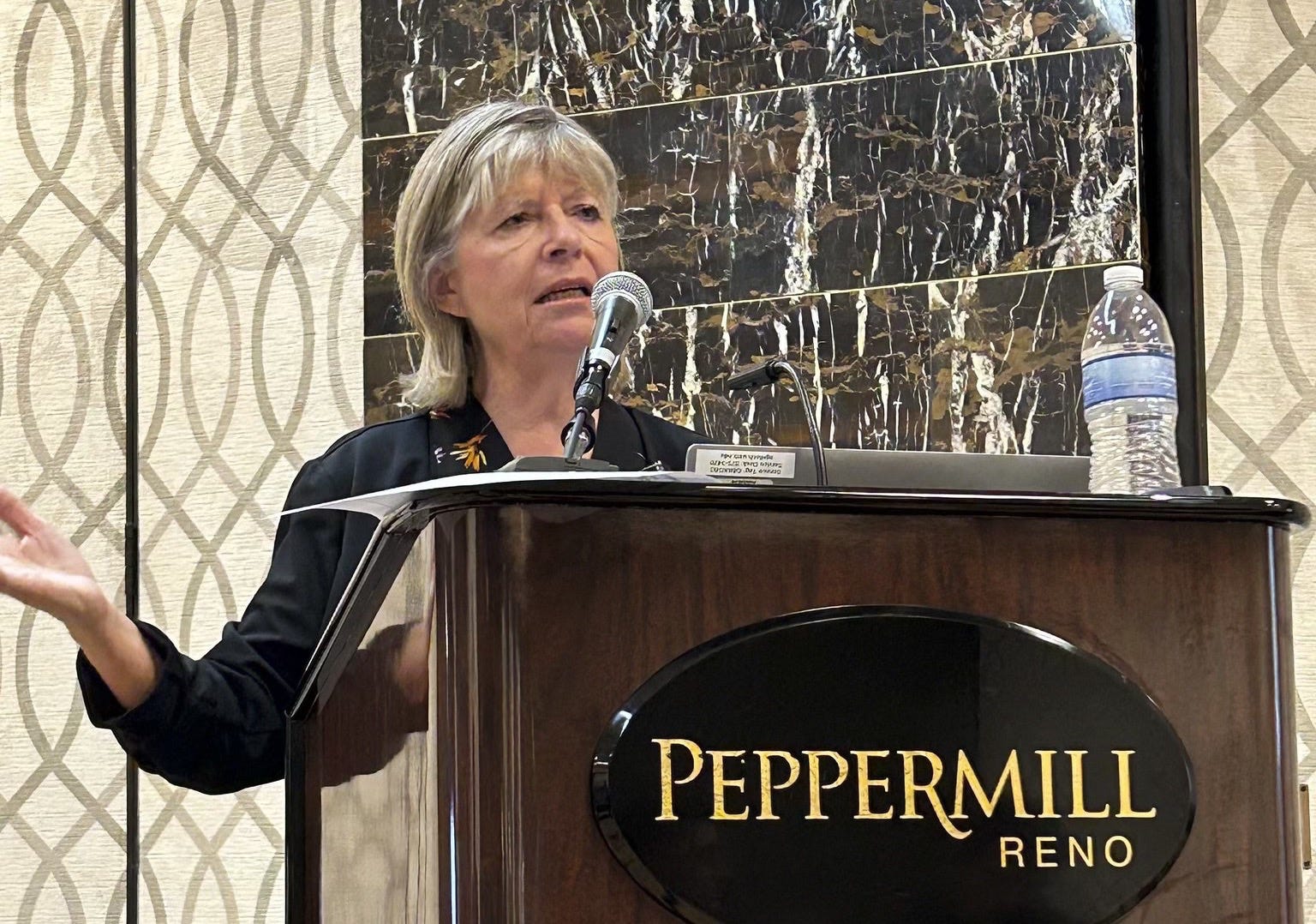
After a long delay, the Interior Department’s Office of Government Ethics last week provided Public Domain the financial disclosure of Karen Budd-Falen, a high-ranking Trump appointee at DOI.
Budd-Falen is a lightning rod figure in western public lands circles. A hero to ranching groups and private property activists, she is scorned by many conservationists for her long history of fighting to roll back environmental protections. In 2024, she represented ranching organizations and other groups in a legal filing that supported Utah’s failed bid to seize control of millions of acres of federal public land — land that she now plays a key role in managing.
Budd-Falen, a veteran of the first Trump administration, has largely flown under the radar since she was appointed in March as associate deputy secretary to Interior Secretary Doug Burgum — a position that does not require Senate confirmation. She temporarily served as Interior’s acting deputy secretary, the agency’s second-highest position, until Kate Macgregor, another veteran of Trump 1.0, was confirmed to the post in May. The administration has released little information about Budd-Falen’s activities at DOI, and public records requests for her calendar and other key documents have gone unfulfilled to date.
But Budd-Falen likely wields enormous power within the Department. Indeed, in a private email to a Republican state official in Wyoming shortly after President Trump’s election victory last year, she wrote, “I certainly don’t want to go back to DC again unless I am the God of Interior which won’t happen!”
DOI’s deputy communications director, Charlotte Taylor, said in a statement that Budd-Falen “is a proven leader bringing decades of experience and knowledge to the Department. She leads this administration’s efforts to manage America’s public lands effectively and responsibly delivering real results for the American people – all while firmly upholding the standards expected of the Department and the Executive Branch.”
Public Domain first requested Budd-Falen’s financial disclosure in March, as part of a large records request. Last week, Interior’s ethics office emailed to apologize for failing to include Budd-Falen’s disclosure in an initial records release earlier this year, calling it an “inadvertent oversight.” The newly released Budd-Falen disclosure, however, appears to be missing a key signature from a DOI ethics official confirming that “the filer is in compliance with applicable laws and regulations.”
The disclosure, which Budd-Falen filed in May, reveals the sprawling extent of her wealth and more than a dozen legal clients she represented in the year before rejoining government. Among other things, she and her husband have major landholdings in the American West and stakes in multiple cattle operations. (The Interior Department is responsible for administering the federal grazing program, which leases public land at low cost to cattle ranchers across the West). And, as of the filing date, she or her husband owned a variety of stocks, including Exxon Mobil and Tyson Foods.
Budd-Falen’s family wealth primarily centers on land. Along with her siblings, she owns ranch land in Big Piney, Wyoming valued between $1 million and $5 million. She also has a “passive interest” in L-F Enterprises LLC, a Wyoming-based cattle and residential real estate company, valued between $1 million and $5 million. And the filing lists Home Ranch LLC, a Nevada ranching operation valued at over $1 million that has historically had permits to graze cows on federal allotments. The income generated by these holdings is well over $1 million, according to her disclosure.
Her family’s stock holdings, meanwhile, were listed in the filing as including between $15,000 and $50,000 in oil giant Exxon Mobil, between $15,000 and $50,000 in oil and gas pipeline company Enterprise Products Partners, and as much as $15,000 in Tyson Foods, the agribusiness giant. The filing reports that prior to joining Trump’s Interior Department, she transferred her ownership stake in her family’s law firm to her husband. The firm, formerly known as Budd-Falen law offices, is valued at over $1 million.
Budd-Falen’s recent legal clients include Wyoming county commissioners, a Wyoming landowner group, a North Dakota county planning and zoning department and several named individuals. She reported income from “Almond of California,” an apparent reference to an industry trade group; “Oregon Spotted Frog” in Madras, Oregon, which appears to be tied to her pushback against against federal efforts to expand protections for the threatened frog; and “WY Sage Grouse Consistency,” likely a reference to the long-running political squabble over greater sage grouse protections, an issue Budd-Falen has been involved in for years.
Aaron Weiss, deputy director of the Center for Western Priorities, told Public Domain that Budd Falen’s financial disclosure raises more questions than it answers, but underscores the potential conflicts of interest that surround her appointment at the Interior Department.
“Why has [the financial disclosure form] not been certified by a designated ethics official? Why has Interior not released her ethics agreement? Did she even sign one,” he said in an email. “According to this form, she returned to Interior in March and still held Exxon Mobil stock as of May. She’s making millions of dollars a year from her cattle ranches. If Budd-Falen were to work on any sort of grazing policy at Interior, she would be in a position to further enrich herself.”
During the first Trump administration, Budd-Falen was being considered to lead the Bureau of Land Management, an agency she has sparred with during her long career. But when she was told she and her husband would have to sell their interests in their family ranches to avoid conflicts of interest, she turned down the BLM director job, she told The Fence Post in 2018. She and her husband kept the ranches and she instead became Interior’s deputy solicitor for wildlife and parks.
Much like that job, her current post allowed her to avoid the scrutiny of a Senate confirmation process, where lawmakers have the opportunity to ask questions about potential conflicts of interest. In this second Trump administration, where she is serving as associate deputy secretary, she is in an even more powerful position to influence government policy.
Enlightening and alarming. Where does the corruption end?
This person is the epitome of underhanded maneuvering for personal enrichment and power, posing as a " aw gosh darn westerner" while having no respect or love for the very land she rapes and pillages through destructive mining, unregulated grazing, unbelievably harmful fencing covering thousands of acres, impeding migratory patterns, and consequently showing deep disregard for its very endangered wildlife that she professes to love, while she crawls under the radar of regulations. Another robber baron in disguise.