


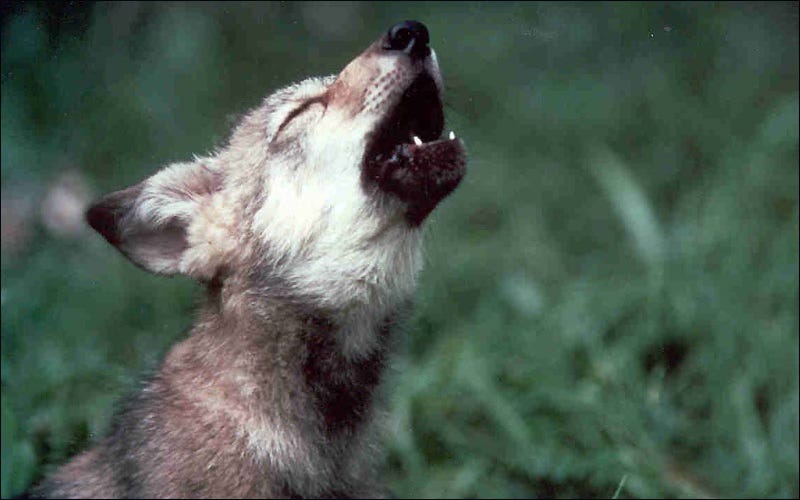
Idaho wildlife officials will consider measures to limit payments to hunters who kill wolf pups, following a report co-published by Public Domain and the Guardian.
At least three hunters killed 12 wolf pups in April, including what appeared to be at least one full litter. The hunters collected $24,000 for killing the animals through a state-administered fund designed to incentivize wolf killing. The hunters appeared to target the wolf pups at their dens.
A coalition of petitioners led by the International Wildlife Coexistence Network asked Idaho Fish and Game commissioners last week to adopt rules that would protect wolf pups and lactating mothers, ban wolf hunting at dens and bar hunters and trappers from collecting payments for killing wolf pups. Idaho already prohibits the killing of young juveniles for other large carnivores hunted in the state, like black bears and mountain lions, the petition notes.
“The time is ripe to ask for rulemaking, for wolf pups to be protected like other predators’ young,” said Dallas Gudgell, who presented the petition Tuesday at a public meeting of the Idaho Fish and Game Commission in Lewiston.
“This opens up a deeper question not only about wildlife management, but where our tax dollars going,” Gudgell said. “Why are we contracting with these ruthless killers that are killing pups?”
State wildlife officials had already attempted to avoid incentivizing hunters and trappers to kill wolf pups at their dens in response to a 2024 report from the Idaho Statesman, Fish and Game Director Jim Fredericks said Wednesday at the commission’s business meeting.
“That practice is distasteful to many people, sportsmen and -women included,” Fredericks said. “It’s not in line with the original intent of the reimbursement program.”
Watch Idaho Fish and Game Director Jim Frederick’s comments in the video above, starting at approximately 9m20s.
Starting in January of this year, Idaho officials prohibited using state funds for reimbursing hunters and trappers for killing wolves in the months of May or June, when pups are still young.
But denning season begins well before those months. The wolf pup killings originally reported by Public Domain and the Guardian occurred in April.
“Idaho protects bear and mountain lion cubs,” Suzanne Asha Stone, who leads the International Wildlife Coexistence Network, wrote in a statement. “Idaho promised during federal delisting to manage wolves the same way it managed these other native carnivores. Instead, it pays people now to kill wolf pups before their eyes open.”
The commissioners will consider the petition at a meeting in January, according to the Lewiston Tribune.
Idaho funds wolf kills with a mix of public and private money that the state describes as “reimbursement” and that wildlife advocates deride as “bounties.” The Foundation for Wildlife Management, a nonprofit that aims to boost wild deer and elk herds, distributes the funds and contributes some of the money. The foundation did not respond to a request for comment.
Hunters and trappers who kill wolves in Idaho can apply for reimbursement of expenses through the foundation for up to $2,000 per wolf. The foundation then asks Idaho Department of Fish and Game to repay it from a fund that includes both general tax revenue and department money from hunting and fishing license and tag sales.
The foundation defines “reimbursement” loosely, including expenses that any person living in Idaho would typically incur, like the cost of buying clothing or an automobile. The foundation invoiced Idaho Fish and Game for the maximum payment for every one of the roughly 160 wolf kills reviewed by Public Domain, which account for just a portion of the current hunting season.
Idaho Fish and Game Commissioner Tim Murphy urged the Foundation for Wildlife Management to stop reimbursing hunters and trappers for killing wolf pups at Wednesday’s business meeting. Targeting pups at dens violates “fair chase,” a widely embraced hunting ethic dictating that pursued animals should have a fighting chance of getting away.
An unidentified woman took credit for some of the wolf killings on Facebook earlier this month, posting an image of six small pups lined up along a felled log.
State records showed contradictory information for some of the pup killings, saying that a rifle was used to kill all 12, but in some cases also saying that no weapon was used, which activists say indicates that they may have been killed by hand. The image posted to Facebook did not appear to show bullet wounds, though the carcasses were only viewable from one angle.
The woman later removed the image, writing that she had faced threats after posting it. She did not respond to an interview request.
Eradication campaigns waged for much of the 20th century to shield livestock from predators left wolves nearly extirpated from Idaho until the U.S. Fish and Wildlife Service began restoring them in 1995 under the Endangered Species Act.
Wolf populations have bounced back across the northern Rockies since then. Congress removed Endangered Species Act protections for wolves in Idaho and Montana in 2011, putting the species back under state management.
But growing wolf numbers reignited the same tensions with ranchers that had nearly wiped them off the map. In 2021, the Republican-dominated state legislature passed a bill that reduced weapons restrictions, permitted year-round trapping on private land and allowed the state to contract with third parties to kill wolves. The state established the wolf payment fund to incentivize hunters and trappers to kill wolves the same year.
The 2021 law could make it challenging to enact the petition without legislative action, director Fredericks said at Wednesday’s business meeting.
Idaho’s wolf numbers peaked at about 1,600 animals in the spring of 2019, ahead of the passage of the controversial wolf-control law, according to Idaho Fish and Game. More aggressive hunting and trapping had pushed their numbers down to about 1,100 last year.
Idaho Fish and Game is currently trying to reduce wolves to a spring population of 650. Wolf numbers are highest in spring, after new litters are born.