


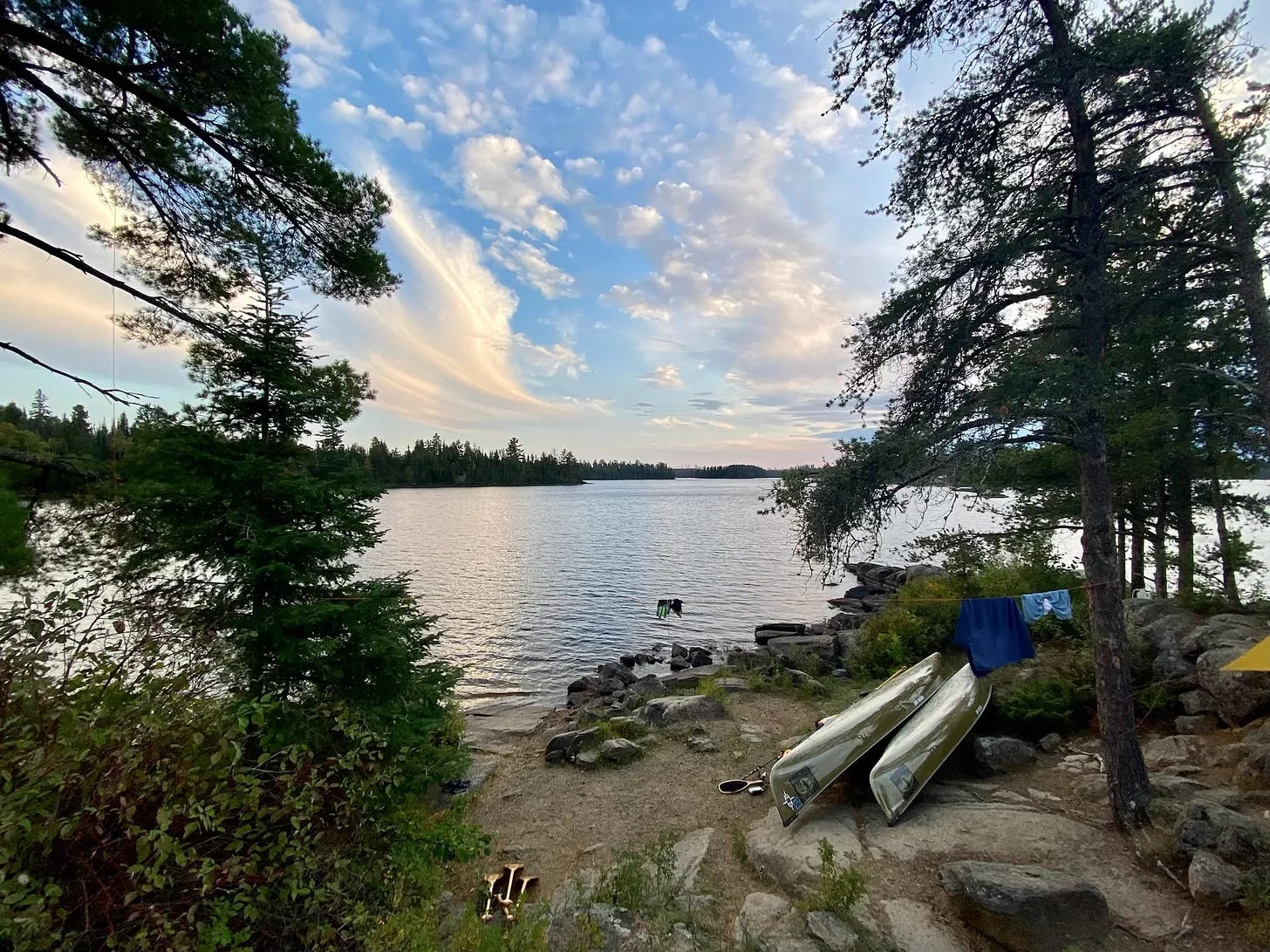
The House of Representatives voted 214 to 208 Wednesday to open up hundreds of thousands of federal acres to mining near the border of Minnesota’s Boundary Waters Canoe Area Wilderness.
The vote marked a major test of whether the House Public Lands Caucus would speak with a unified voice on conservation issues, despite its gaping partisan divide. The Public Lands Caucus launched back in May, vowing to “work across the aisle to advance policies for the conservation of and public access to public lands.”
But on a contentious issue pitting conservation against industrial development, the Public Lands Caucus voted entirely on partisan lines, with all 11 Republicans voting in favor and all 11 Democrats voting against.
The Bureau of Land Management under the Biden administration withdrew more than 200,000 of federal land from mineral leasing for 20 years to avoid polluting the Boundary Waters, a popular destination for paddling, camping and fishing. The withdrawn area is part of the Duluth complex, a geologic formation with major deposits of copper, nickel and cobalt.
But House Republicans, led by Rep. Pete Stauber (R-Minn.), voted to overturn the withdrawal Wednesday, leveraging a law called the Congressional Review Act that gives Congress the power to override agency rules. The law’s Republican champions described it as a step to unlock the region’s mineral wealth, while making the country less dependent on Chinese minerals.
“These are good mining jobs,” Stauber said on the House floor, adding that labor unions and the construction industry backed the project. “If anyone knows how to mine, it’s the Minnesota miner. It’s better in our backyard than China, Russia or other adversarial nations. Minnesota has been mining for 145 years. We know how to do it.”
Conservationists widely decried using the Congressional Review Act to challenge the Boundary Waters mining withdrawal as an unprecedented step that could open the door to challenge other public land protections.
The Government Accountability Office has yet to rule on whether the CRA applies to public land rules like the one used to shield the Boundary Waters, Rep. Jared Huffman (D-Calif.) said on the House floor.
“If this CRA succeeds, it won’t just open the Boundary Waters to pollution, but would set a terrible and dangerous precedent for Congress to roll back protections for any of our treasured public lands with little oversight or notice just because Republicans have decided they’d rather pillage them for profit,” Huffman said.
Ahead of the vote, Rep. Ryan Zinke (R-Mont.), a co-chair of the caucus who was credited with helping block a GOP effort last year to sell off federal lands, worked to whip colleagues to vote for Stauber’s legislation. Zinke’s chief of staff, Heather Swift, told E&E News that Zinke has been clear in his position on mining projects like the one Stauber’s bill targets.
“The mine is a good project with a strong safety plan and the palladium group metals that will be mined there are critical for national security, green energy, and tech security,” Swift told the publication.
Twin Metals has pushed since 2019 to establish a mine in the area for copper, nickel and cobalt. The company is owned by Chilean mining giant Antofagasta.
While Zinke voted for Stauber’s bill, Rep. Gabe Vasquez (D-N.M.), the other co-chair of the Public Lands Caucus, opposed it. In a social media post on Monday, Vasquez wrote that the Boundary Waters “are an irreplaceable Wilderness Area that represent the best of America’s public lands” and urged his colleagues to vote down Stauber’s measure.
Public land advocates, including hook and bullet groups, had hoped that the caucus might act as a backstop against this sort of legislation. In an op-ed earlier this week, Ryan Callaghan, the CEO of Backcountry Hunters and Anglers, and Steve Rinella, the founder of Meateater, described Stauber’s bill as “a test of whether cherished public lands across the country can be stripped of protections through procedural shortcuts.”
“This is also where the bipartisan Public Lands Caucus in the U.S. House of Representatives comes into the picture,” they wrote. “Created to help shield America’s public lands and waters from dangerous ideas in Congress, HJR 140 is exactly the kind of proposal they must work together to stop.”
In the end, the caucus fell short of conservationists’ hopes. For anyone who has followed closely, that may not come as a huge surprise. After launching in May, the caucus largely went dark — no press releases and few media mentions for months. It wasn’t until November that the bipartisan body endorsed a piece of legislation. And it didn’t pull together its own website until last month.
Late last week, with the Boundary Waters issue dominating much of the conversation in the public lands space, Zinke and Vasquez sat down with Callaghan for an interview to discuss America’s shared lands and resources. Callaghan did not bring up Stauber’s legislation, but asked for an update on the caucus.
“Is the Public Lands Caucus working? Is it growing? Is your passion, Rep. Zinke, getting out to others?” Callaghan asked.
Zinke’s meandering answer touched on the importance of “education,” the appropriate process for divesting and selling federal acres and the need to involve the public in those discussions.
“Those of us in the West, that grew up here and live there, we’re pretty passionate about making sure that the legacy that was given to us is protected for the next generation,” Zinke said.
In 2018, while serving as Interior secretary during the first Trump administration, Zinke approved a 20-year ban on new mining across 30,000 acres of public land north of Yellowstone National Park.
“There are places where it is appropriate to mine and places where it is not,” Zinke said in a statement at the time. “Paradise Valley is one of the areas it’s not.”
Zinke echoed that same point in a fiery speech Wednesday on the House floor, saying “there’s a place to mine and there’s a place not to mine.” But unlike the proposed gold mines outside Yellowstone, which he effectively blocked, Twin Metals would be a “good mine, a good project,” he argued.
“When a mine is not located in the wilderness, it’s not located in the buffer, it’s located in a Forest Service holding, which by nature, which by law, is multiple use,” he said. “And mining is an appropriate use.”
Poll after poll has shown that a majority of Minnesotans oppose mining at the edge of the Boundary Waters.
The resolution now heads to the Senate for consideration.
So what does is a " good paying" job men when you no longer have clean, water to drink, clean soil to farm in or clean air to breath. Copper mining is none of the above. The GOP, is signing your life away because after all, they are, the Party of Death. Let's make sure Stauber gets all his future drinking water from the copper mining catch basins!
Destroying the Boundary Waters wilderness for the money to be made through minerals extraction is a terrible mistake that will have devastating, very long-lasting consequences for an environment that is irreplaceable. Votes to support this activity shred my faith in humanity, to be honest.