


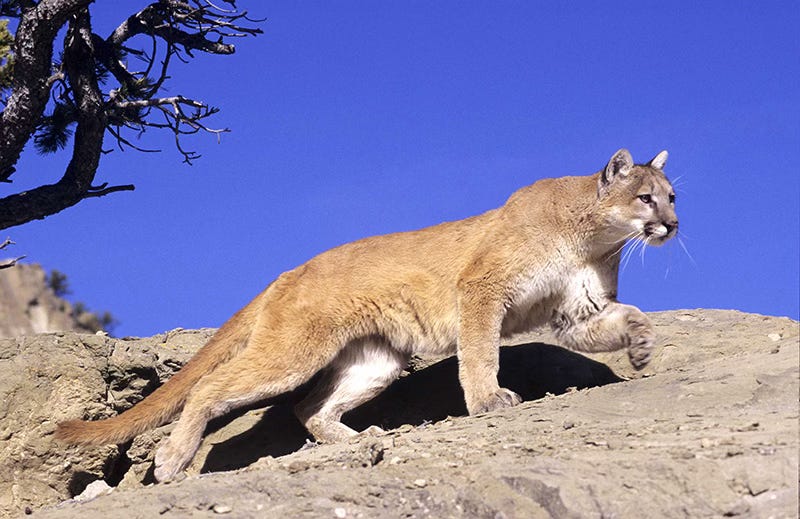
.jpg)
By outside standards, the proposal that Texas Parks and Wildlife Department put forth for consideration last month sounded modest — hunters and trappers would have to report mountain lion kills within 24 hours. Within two months of harvest, they would have to turn in a molar to help confirm the animal’s age. Those practices are common in every other state that allows cougar hunting.
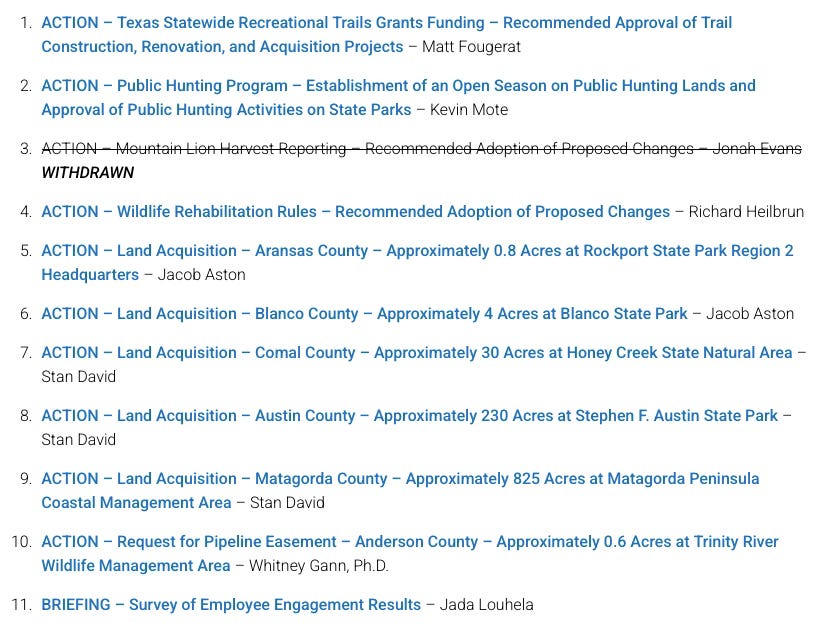
But in Texas, the only state where mountain lion hunting and trapping remains virtually unregulated, the proposal met staunch opposition from the livestock industry and a social media campaign so fierce that wildlife officials quietly struck it from the agenda ahead of last month’s Texas Parks and Wildlife Commission hearing. The agency has tabled the proposal for a year, Wildlife Conservation Director Jonah Evans told Public Domain.
The agency’s backtracking ahead of last month’s wildlife commission hearing incensed advocates, who have long pushed for better data collection and a rethink of the state’s hands-off lion-hunting regulations.
“We just don’t have good population models for mountain lions,” said Jake Walker, a spokesperson for Texas Backcountry Hunters and Anglers. “Step one is to get some kind of harvest reporting on the books so we can start building these models. It’s a no-brainer in conservation circles.”
The proposal would not have imposed any changes to mountain lion hunting in Texas, which is unique for classifying cougars as a “non-game” species, like wild hogs or prairie dogs. Any private-land hunter can kill any lion without regard to season, bag limits or the tags generally issued to pursue big game animals. (Few public land opportunities to hunt cougars exist in Texas.)
But even modest changes to cougar hunting invite conflict in Texas, where wildlife politics have become increasingly polarized in recent years. Some 95 percent of land is privately held and landowners at times bristle at state-imposed mandates to manage wildlife.
“You can’t just jump to mandatory reporting, especially when you rely on private property owners to do a whole host of things,” Peyton Schumann, a spokesperson for the Texas and Southwestern Cattle Raisers Association, told Public Domain. “Without us, there would be a lot of science and data that is not collected. We have to open our gates to let the researchers in here.”
In podcasts and Facebook posts, critics accused Texas Parks and Wildlife Department of colluding with lion-loving animal rights activists and plotting to undermine cougar hunting over the long term.
“Texas Parks and Wildlife has been infested with anti-hunting ideologies from the top down,” host Cable Smith said on an April 28 episode of the Lone Star Outdoor Show podcast, adding: “What we don’t want are animal rights activist ideologies proliferating our state’s wildlife management agency, but they are.”
Facing such hostility, wildlife officials feared they were losing the trust of the very people they would need to comply with the new rules, said Evans, the state wildlife conservation director.
“The core of wildlife management is relationships and partnerships and trust,” Evans said. “It’s clear to me that in this situation some element of that wasn’t as strong as it needed to be.”
A three-decade debate
The Texas-style free-for-all on mountain lions was once common across the West, where states hunted, trapped and, in some cases, systematically poisoned carnivores to keep them from attacking livestock. It was common for authorities in western states, where mountain lions are most prevalent, to offer bounties to kill cougars until the 1960s.
By then, it started to become clear that lion populations were dwindling in the face of unregulated hunting. Today, every state other than Texas with an active mountain lion hunt classifies the species as a big game animal. Mandatory harvest reporting is also standard in every state where lions are hunted or trapped.
State game agencies imposed those rules partly because mountain lion populations are hard to survey. They are stealthy and tend to avoid humans. They roam over vast home ranges. Like all large carnivores, there are relatively few of them on the landscape even when their populations are healthy.
Those small population numbers also make them vulnerable to over-hunting. Lion advocates have worried for decades that Texas may be flying blind while cougar numbers crater, as they did in states across the West half a century ago.
TPWD considered requiring the reporting of all mountain lion kills back in the 1990s, after receiving a petition from activists. Instead, the department settled on voluntary reporting, while commissioning research. Interest in the issue faded.
“People move on with their lives, attention wanes,” Evans said. “But it did become very clear that voluntary reporting did not work. It has zero correlation to what mountain lion populations are doing as a whole.”
In 2022, the department received a similar petition from an activist group called Texans for Mountain Lions. Texas Parks and Wildlife staff recommended denying the petition, but fielded a stakeholder group to revisit mountain lion regulations.
The commission has already adopted some of the petition’s suggestions, like imposing a 36-hour trap check and banning “canned” cougar hunts, in which game ranchers release captive animals the morning paid clients arrive to ensure success. (Critics maintain that canned lion hunting was uncommon before it became a class C misdemeanor, punishable by up to a $500 fine.) But mandatory kill reporting remains the most controversial issue.
Texas wildlife officials know little about mountain lion populations. The few detailed studies that biologists have carried out since the 1991 petition indicates that lions are struggling in at least some parts of their range.
“If you look at every mountain lion study in Texas, every single one puts the adult female mortality in the range where you would expect to see a declining population,” Evans said. “We see genetic concerns in south Texas. We already have data that make it look like mountain lions aren’t doing great.”
But without accurate hunter harvest data, wildlife officials don’t have a cost-effective way to know for sure.
“For a population model, we need to know the total amount of mountain lion human harvest that’s occurring in the state,” Evans said. “With a voluntary report, we don’t know if we’re getting 50 percent, 10 percent, 100 percent … Voluntary data, as far as we know, is essentially useless for this purpose.”
Killing a ‘record number of mountain lions’
Jeremy Harrison, one of the proposal’s most prominent critics, viewed it with suspicion partly because Texans for Mountain Lions had petitioned for it. Harrison organizes the West Texas Big Bobcat Contest, the self-described “highest-paying hunting contest in the country.” The event has drawn a slew of negative media portrayals, including a short documentary co-produced by Pamela Harte, one of the founders of Texans for Mountain Lions. (Texans for Mountain Lions did not respond to an interview request.)
In Harte and her lion-advocacy group, opponents like Harrison see a growing influence of animal rights activism in Texas wildlife politics that aims eventually to ban predator hunting in Texas altogether. They want more robust data, Harrison says, largely because publishing it will make hunters look bad.
“Whether the mountain lion harvest is 12 mountain lions next year or 1,200 or 12,000, it won’t matter — the headline will be, ‘Texas hunters kill record number of mountain lions,’” Harrison told Public Domain. “It will stoke an emotional response from an unknowing public.”
Harrison also echoed the livestock industry’s concerns about Texas officials telling landowners what to do in a state that has no tradition of regulating lion hunting. Hunters like him want thriving cougar populations, but landowners will be less likely to comply with new rules if they feel they’ve been strongarmed, Harrison said. He suggested that Texas Parks and Wildlife Department should instead offer a raffle ticket for one of the state’s annual premium hunt drawings to lion hunters and trappers for each carcass reported and tooth submitted.
“I’m not against this harvest program, I’m against the mandatory part,” Harrison said. “The last thing I want to do is wipe out any species. If I thought for a second that we were wiping out mountain lions, I would be the one pushing for regulations.”
Concerns about “weaponizing data” are legitimate, said Romey Swanson, a field ecologist who has worked with Texans for Mountain Lions. But data is a double-edged sword. If more detailed reporting indicated that the population might be struggling in some part of the state, wildlife officials might one day step in to limit hunting and trapping there. But if, on the other hand, the population showed cougars on an upward trend in some other part of the state, it’s just as likely that officials could encourage hunters and trappers to kill more lions.
“We keep seeing obstruction for this data collection, but we’re not seeing viable solutions from them,” Swanson said. “Here we are still talking about lions on an issue the book could have been closed on decades ago. It’s going to keep coming up until we have something practical as our operation manual.”
Pressing pause
Whatever the data shows, it will take a long time for it to have any impacts on hunting regulations, said Evans, the state wildlife conservation director. Wildlife officials would need up to 10 years of complete harvest reports just to develop an accurate population model.
The most immediate impact of better data would be allowing local biologists to give landowners better-informed advice on how to navigate problems like livestock predation. In areas where data indicates struggling lion populations, biologists would be more likely to recommend non-lethal options to ease cougar conflicts.
“There’s zero interest in limiting [hunter] harvest,” Evans said. “Right now, the idea is get some good, quality data.”
For the moment, however, the data gap will remain while wildlife officials try to figure out their next move.
Even after the backlash, about two-thirds of those who submitted public comments supported mandatory harvest reporting, Evans said. As a hunter and seventh-generation Texan raised on a ranch, Evans felt frustrated to see his agency portrayed by critics as hostile to hunting. Still, wildlife officials had little choice but to try to build more trust.
“It’s difficult for any large bureaucracy or agency to respond to viral social media content in real time, so this was the right thing to do, to press pause,” Evans said. “If we just pushed through and everyone was adamantly against it, do you think these people are going to follow the regulation?”
CORRECTION: An earlier version of this article referred to Jonah Evans by his old title of Texas State Mammalogist. He now services as Texas Wildlife Conservation Program Director.
The total destruction of mountain lions seems to be the point. And they call it "management."
Killing for sport and pleasure can only be changed from the inside out, from the heart and soul. I love that there are studies like this one on "why we kill animals." If we understand our motivations, we really can work to modify our killing behaviors to improve ecological health as well as wild and domestic animal lives. I'll be in the minority for saying this, but I don't believe we can be whole and healthy without facing this aspect of our humanity.
https://www.sciencedirect.com/science/article/pii/S0048969723039062?via%3Dihub