


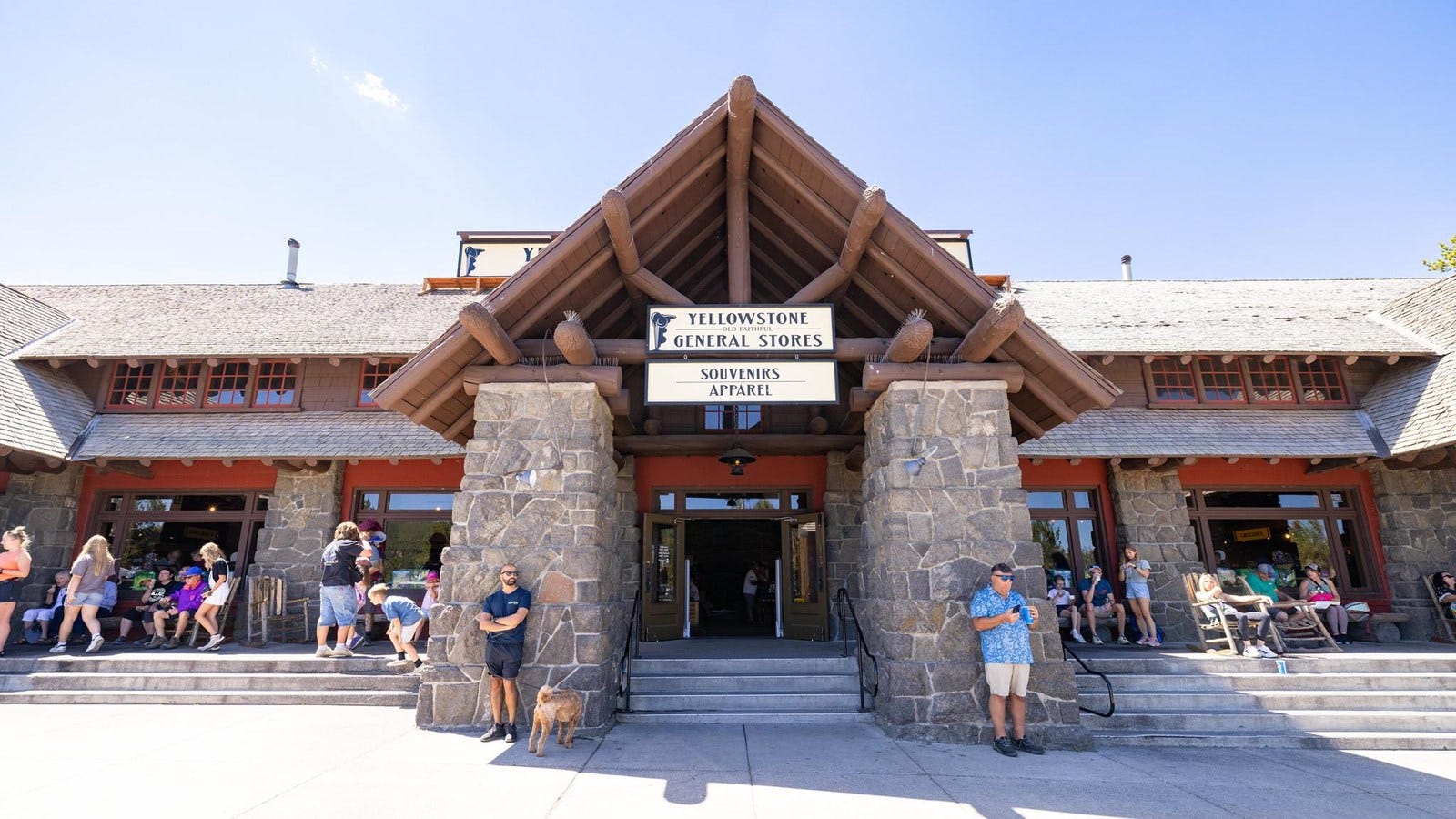
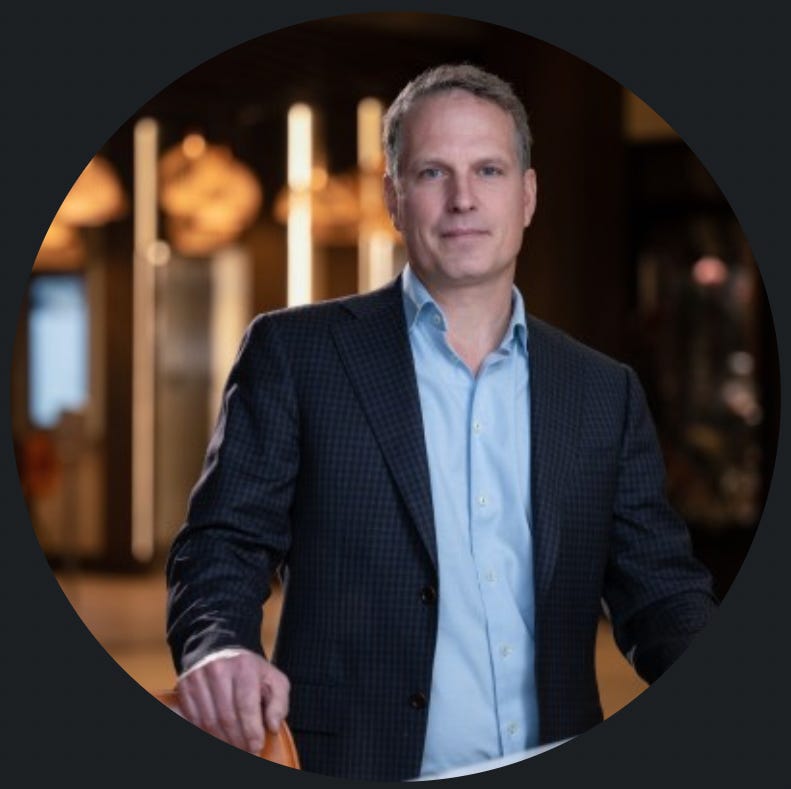
Last month, the Trump administration announced Scott Socha as its new nominee to lead the National Park Service, the most prestigious public lands agency in America, though much diminished since it was gutted by DOGE personnel cuts last year. As with many of the political appointees at Trump’s Interior Department, Socha comes directly from a corporation with abundant business interests before the agency he is slated to lead. He has worked for more than 20 years as a corporate executive at Delaware North, the hospitality and food services giant that controls lucrative concessions at national parks around the country.
Delaware North runs 11 general stores at Yellowstone National Park. It operates the Yavapai Lodge and related food and beverage concessions at Grand Canyon National Park. It manages “lodging, food and beverage, and retail stores” at Kings Canyon National Park and Sequoia National Park in California. It runs the Kalaloch Lodge in Olympic National Park, and has myriad commercial interests in Shenandoah National Park. It also owns a slew of hotels in national park gateway communities and in recent years was enmeshed in an acrimonious trademark dispute over naming rights at Yosemite National Park. With a sprawling array of business interests, the privately-held company generates billions in revenue each year.
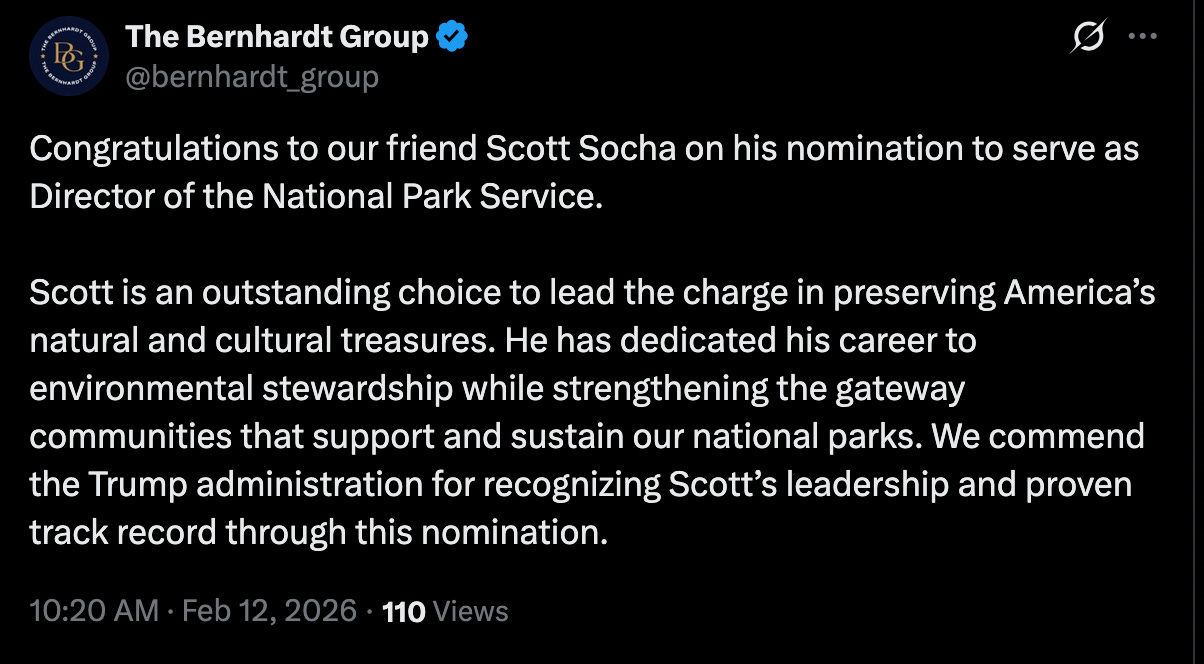
After Trump took office, Delaware North hired The Bernhardt Group to lobby for it in Washington D.C. Founded by David Bernhardt, an interior secretary during Trump’s first term who remains a major figure in Trump World, The Bernhardt Group has taken $140,000 from Delaware North since last summer to lobby the Interior Department and Congress on “issue related to concessions contracts.”
When Socha was nominated to lead NPS, The Bernhardt Group publicly gushed about their friend’s good fortune.
Corporate interests have long been seen as a key threat to the democratic purpose of the national park system. Since the very earliest days of the national parks, private corporations have sought to influence Park Service policy for their own profit. This was the case as far back as 1882, when the Yellowstone National Park Improvement Company tried to obtain a monopoly over thousands of acres within the park’s boundaries to develop hotels and other commercial infrastructure. The company was run by a controversial New York stockbroker and his partners and its plans for Yellowstone aroused fierce opposition from prominent park conservationists, including the writer and naturalist George Bird Grinnell and General Phil Sheridan, a key figure in the destruction of the Confederacy and later an architect of the scorched-earth Indian Wars.
Sheridan, who had many influential political allies, wrote after a tour of Yellowstone in 1882 that he “regretted exceedingly to learn that the National Park had been rented out to private parties…. It has now been placed in the hands of private parties for money making purposes, from which claims and conditions will arise that may be hard for the government and the courts to shake off.”
Grinnell, writing in his magazine Forest and Stream, declared that “Yellowstone Park is not to be put into the pockets of a few speculators without some resistance of the representatives of the people … The Park is for rich and poor alike, and every one should have an equal interest in it.”
These men and their allies worried that Yellowstone would become the next Niagara Falls, a marvel of nature that had been ruinously commercialized for the sake of tourism. Working with their allies in Congress, they managed to effectively kill the Yellowstone National Park Improvement Company’s efforts to obtain monopolistic leases on some 4,000 acres within the park while also working to combat poachers and vandals that were killing off the park’s big game and defacing its geysers. Ultimately, Sheridan sent his cavalry into Yellowstone, and the military assumed control of the park’s administration for three decades.
The Niagara threat, the threat of commercialization inside the parks, re-emerges frequently even in our own day, as it did during President Trump’s first term. Many national parks are already highly developed, featuring fancy privately-managed hotels, cellphone towers, traffic jams and hefty fees. But there are those who want more.
In 2018, Trump’s Interior Department assembled an outdoor recreation advisory committee to make recommendations on national park management and related matters. The committee was dominated by representatives of corporate interests, including top executives from park concessionaires like Delaware North and Aramark, and sparked concerns from Interior Department staff about potential conflicts of interest. In October 2019, the advisory committee unveiled its recommendations to then-Interior Secretary David Bernhardt. Unsurprisingly, the committee called for more private management of National Park Service campgrounds. It called for more commercialization at national parks by bringing food trucks, mobile stores, and other amenities to some campsites. It lauded the expansion of WiFi within national parks. It even sought to reduce senior discounts at some national parks during peak tourism season.
As The Los Angeles Times reported at the time, the committee also called for “‘categorical permissions’ to sidestep environmental impact reviews for campground expansion and development, and new policies to ensure that concessionaires be compensated for investments and assets when a competitor is awarded its contract.”
The recommendations sparked an outcry, with conservationists denouncing this latest effort to commercialize the parks. Senior citizen advocates, including the AARP, also slammed the proposal. The advisory committee was disbanded shortly thereafter, in November 2019.
Scott Socha attended the first meeting of Trump’s outdoor recreation advisor committee in July 2018, according to Interior Department records. In a draft document, he was also listed as participating in a November 2018 meeting of the committee. Socha’s nomination has stirred fears among some conservationists that he will promote more commercialization and privatization within the national park system.
“He’s made a career out of extracting maximum profit from our national parks, not protecting them, making it abundantly clear he’ll be doing the bidding of special interests and corporate interests,” said Jayson O’Neill, a spokesperson for the conservation campaign Save Our Parks. Delaware North, incidentally, is headquartered in Buffalo New York, not too far from Niagara Falls.
The Interior Department, in response to questions about Socha’s nomination, said that the “President has nominated highly qualified individuals to serve in key roles across the Department of the Interior. We respect the President’s authority to select leaders who will advance his agenda and serve the American people.”
Before he can take office Socha must be confirmed by the Senate. His nomination hearing has not yet been scheduled.
Great article keep up the good fight. This administration just will not let up in its corruption.
Hey, Art of the Deal!..going strong for 150 years.
The alternative, go "primitive" campground like @ El Morro in NM..bring your own water 💧