


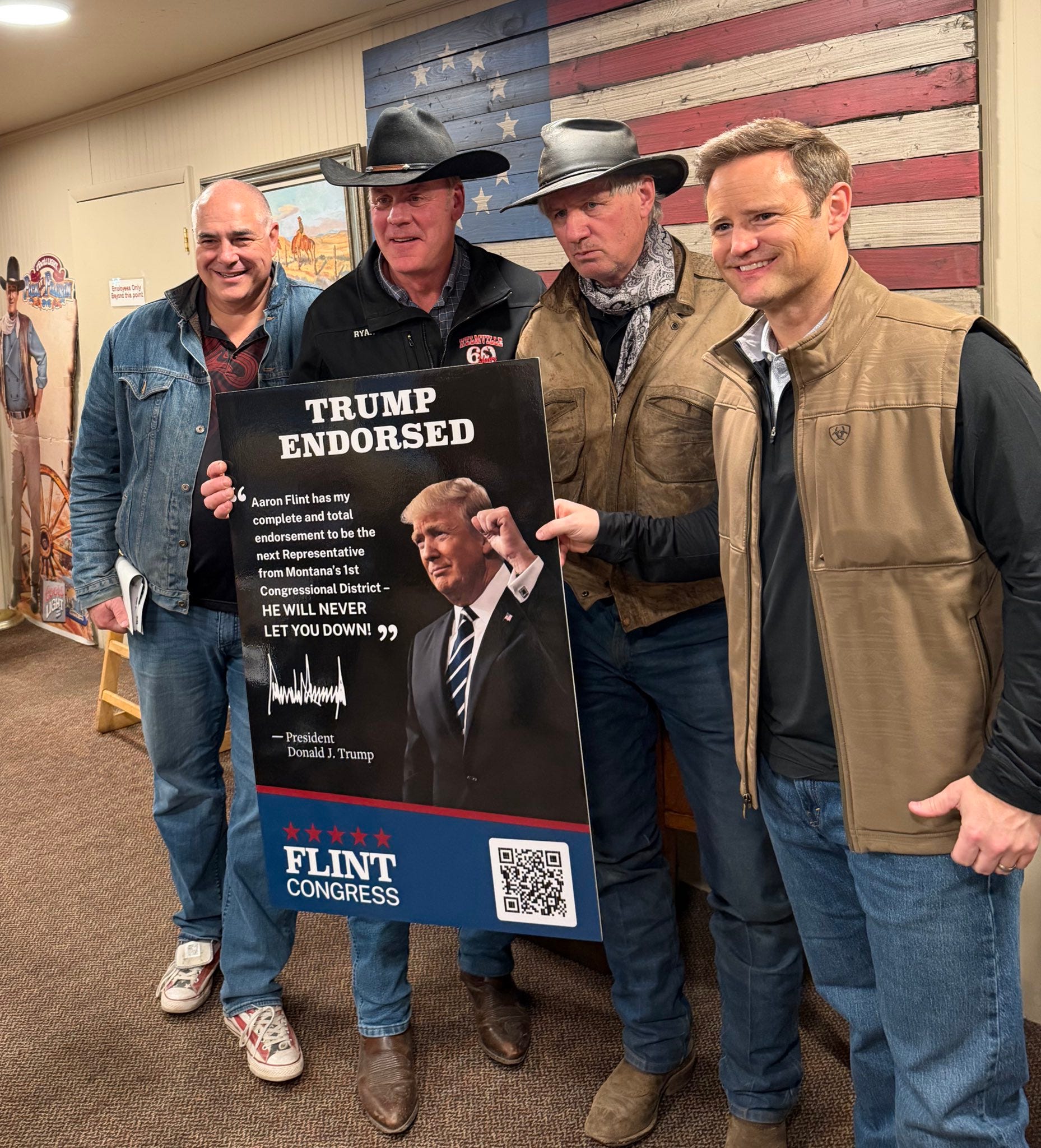
In a video announcing his Congressional bid in Montana last month, longtime conservative radio host Aaron Flint bemoaned the prospect of “public lands being fenced off.”
Flint, the Trump-endorsed veteran running to replace outgoing Montana Republican Rep. Ryan Zinke, has been quick to paint himself as a champion of federal public lands — a smart move for anyone seeking elected office in The Treasure State, where polls show that federal lands are wildly popular.
“Public lands in public hands,” Flint told Northern Ag Network radio in a mid-March interview. “I’m so proud of our Republican congressional delegation who led that charge to protect our public lands. I stood with them then and I will stand with them defending our public lands moving forward.”
Montana’s Republican delegation — Zinke, Sen. Steve Daines, Sen. Tim Sheehy and Rep. Troy Downing — was widely credited with helping block a GOP effort last year to sell off millions of acres of public lands under the guise of combating America’s housing crunch. Zinke and Daines both announced in early March that they will not seek reelection.
But if Flint wins the election, it is unclear whether he will fortify or undermine this so-called “Montana firewall” against federal land divestment. Flint enters his race with a history of voicing support for transferring federal lands to state control — a move that would forever strip them from the broader public’s hands and could ultimately lead to privatization.
"If the state of Montana is doing a better job managing their land, then why do we want the federal government to own the land,” Flint said during a 2014 interview with fellows at the Property and Environment Research Center, or PERC, a Montana-based nonprofit that has a history of advocating for the privatization of federal acres. “If you really were an environmentalist, you would be supporting efforts to get some of this federal land back into state hands because the federal government is failing right now.”
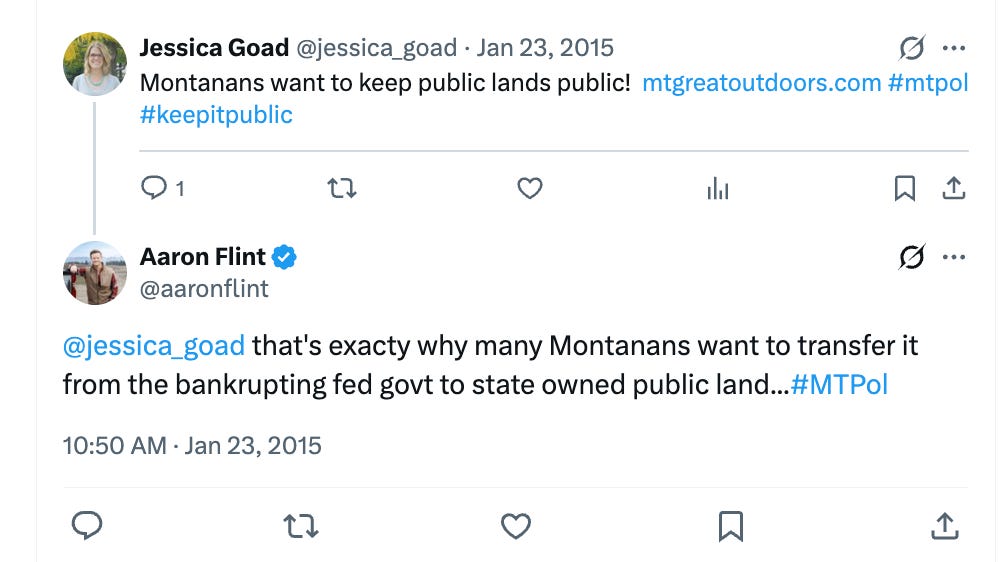
In a 2015 post to X (formerly Twitter), Flint declared that “many Montanans want to transfer it from the bankrupting fed govt to state owned public land.”
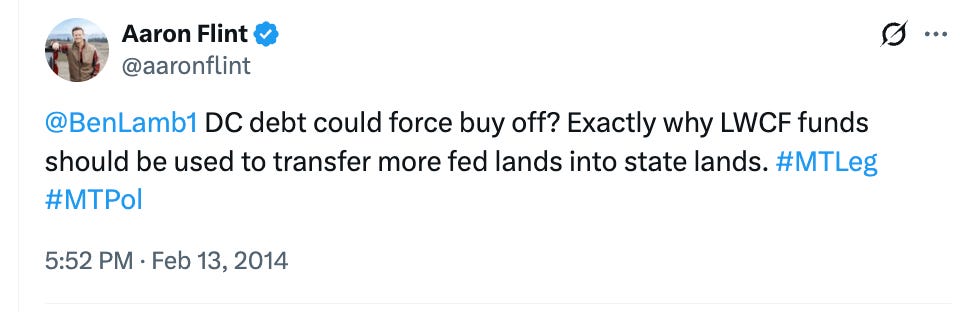
In another post from 2014, he argued money from the popular Land and Water Conservation Fund, which uses oil and gas revenue to acquire and protect lands and water resources, “should be used to transfer more fed lands into state lands.”
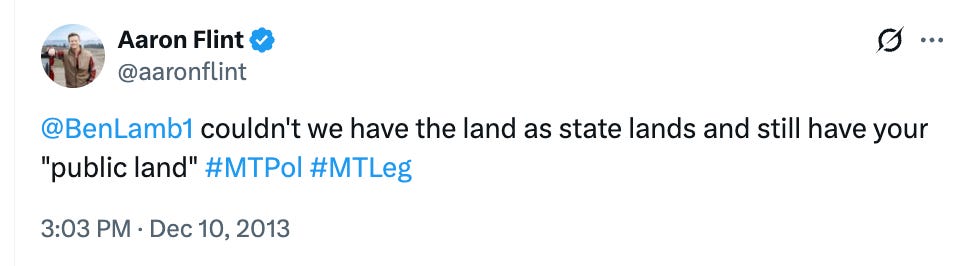
Here are a few other things Flint has had to say about federal public lands over the years:
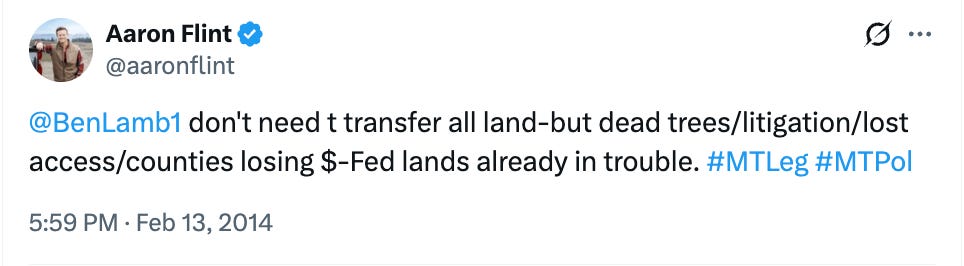
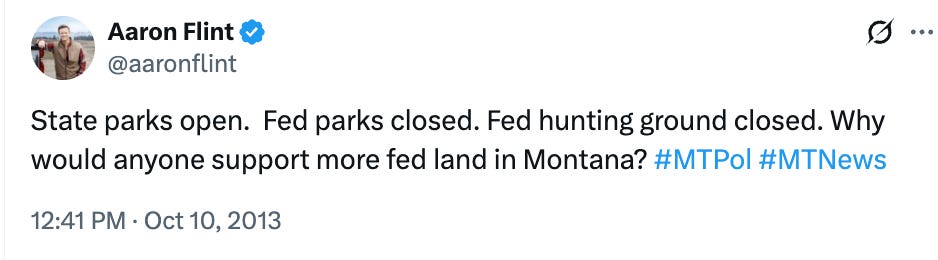
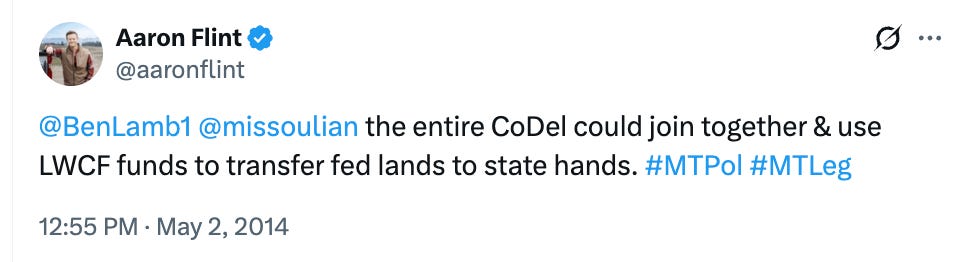
In response to Flint’s pro-public-lands social media post last month, a Public Domain reporter noted in a post to X that the current Montana Republican Party platform, adopted in June 2024, calls for “relinquishing federally managed public lands to the states in order to secure statehood equality and provide for better management of public lands.”


Heather Swift, a longtime spokesperson for Zinke, swooped in with a Trumpian defense of Flint.
“Let me introduce you to a wild concept that the liberal brain can’t comprehend: differing opinions,” Swift wrote on X. “In 2016 Zinke resigned as a delegate in protest of the party plank to sell public lands. In 2025 Zinke defeated GOP attempts to sell public lands. And candidate Flint opposes the sale of public lands. THANK YOU FOR YOUR ATTENTION TO THIS MATTER.”
But Flint’s past pronouncements, issued back in 2015 long before voters were paying attention to him, align with that of the Montana GOP platform.
“Arguably the members of the federal delegation should be leading the Montana party not ‘differing’ with it,” Dave Chadwick, a former executive director of the Montana Wildlife Federation, wrote in an email to Public Domain. “Either they are brazenly misleading their own party grassroots leadership by including transfer language which they then oppose, or they are misleading the rest of us by saying that they oppose it.”
“If Flint wins the primary, he will also be a voting delegate to the 2026 Montana GOP platform convention,” Chadwick added. “Will he support transferring federal public lands to the state or will he disregard the Montana GOP platform?”
Montana Republicans have a history of running away from pro-land-transfer positions once they come face-to-face with their state’s voters. Polls show Montanans deeply oppose federal land sales and transfers. A 2026 survey conducted by the University of Montana found that 84% of Montana voters support a ban on the sale or transfer of national public lands.
Sheehy called for federal lands to be “turned over to state agencies, or even counties” in a podcast interview shortly after launching his bid for Senate in late 2023, as Public Domain co-founder Chris D’Angelo previously reported for HuffPost. Sheehy spent the remainder of the campaign working to distance himself from those comments and PERC, where Sheehy served as a board member.
Flint was among those who came to Sheehy’s defense at the time. In an interview with Sheehy on his Montana Talks radio show, Flint railed against “BS” TV ads “lying” about Sheehy’s public lands agenda. Flint’s radio show guests over the years also included William Perry Pendley, who served as acting director of the Bureau of Land Management during the first Trump administration and has a long history of advocating for federal lands to be sold off.
Flint’s campaign did not respond to queries about whether he disavows his past pro-land-transfer statements. Have his views changed? If so, why? The aspiring Congressman did not answer these and other questions.
Flint’s Democratic opponents, meanwhile, slammed his past statements.
“Western Montana needs representatives who will fight like hell to defend public lands and oppose public land transfer and privatization,” said Sam Forstag, a progressive Forest Service smokejumper who is running in the Democratic primary for Zinke’s old seat, “that’s exactly why I’m running.”
Ryan Busse, a Democrat from Kalispell and former gun industry executive who is also running for Zinke’s seat, said “the veneer that the Republicans and Democrats are the same on public lands is pretty much gone here.”
“I think this is going to be a big, big moment for public lands here,” Busse added. “This will be an election where it finally is front and center.”
This story has been updated with comments from Flint’s interview with PERC in 2014.
It’s so hard to know what to believe when Trump and most Republicans lie so much. I’m not saying there are no corrupt Dems but the right is loathsome.
Flint would actually be worse than Zinke so the bar is set rock bottom low.
There are many well qualified Dems running so hopefully we can get that seat back.
Zinke is a drunk and often shows up shit faced drunk, slurring words. I guess that's his health issue that is his reason for not running again. I think he was afraid he'd be soundly defeated. We hope he moves to Santa Barbara permanently, never to be seen again in MT.