


As federal agents last month gunned down American citizens in the streets of Minneapolis, President Trump’s GOP operatives and allies were waging another sort of war on Minnesota — a ferocious legal and legislative attack on the North Star State’s most important wildlands and the environmental advocates fighting to protect them. A central player in this ongoing effort is Rep. Pete Stauber (R-Minn.), with help from political figures tied to Trump’s Interior Department.
Late last month, just days before masked federal agents shot ICU nurse Alex Pretti in the back, the House of Representatives, at Stauber’s urging, voted to roll back a ban on mining in Minnesota’s Superior National Forest. The 20-year “mineral withdrawal,” first implemented during the Obama years, had been reestablished by the Biden administration to protect the crown jewel of Midwestern federal lands — the Boundary Waters Canoe Area Wilderness. The GOP vote to rescind the ban relied on an arcane legal maneuver and was a handout to one primary beneficiary — the Chilean mining giant Antofagasta Plc and its subsidiary Twin Metals Minnesota, which are seeking to build a copper-nickel mine on national forest land just outside the borders of the Boundary Waters. Conservationists see the mine as a major pollution risk that could contaminate the region’s interconnected waterways, including the lakes and rivers within the wilderness area itself.
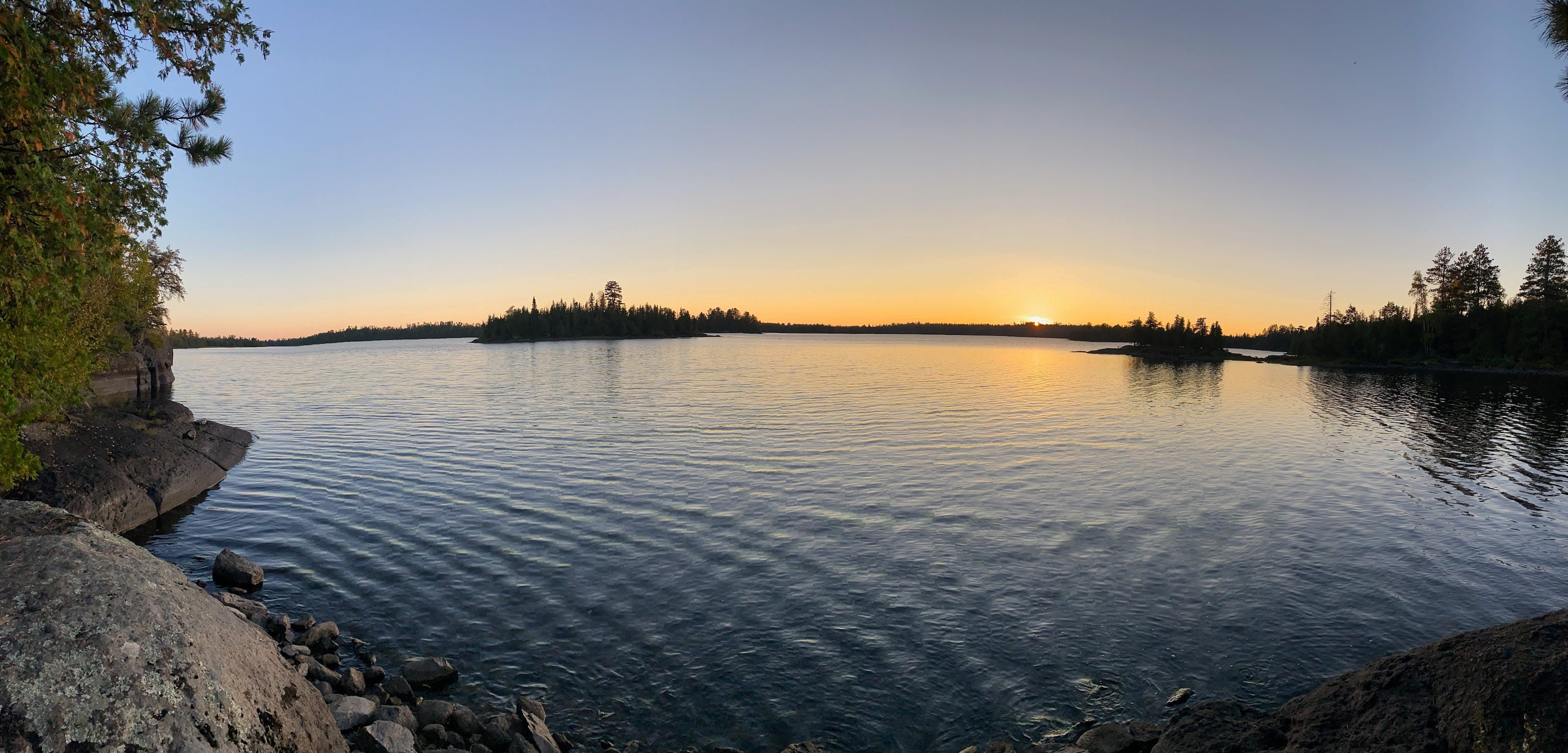
The Boundary Waters wilderness is a pristine landscape of glacial lakes and forests along the Canadian border of northern Minnesota. At more than a million acres, it is one of the nation’s largest and most popular federal wilderness areas, a refuge for wolves, bears, loons, eagles and more. The wilderness area sits in a region which contains a major complex of copper, nickel and other platinum-group minerals. As AI data centers, electric vehicles and the like drive up copper prices, Twin Metals Minnesota wants those riches, and has worked the levers of power in Washington D.C. for more than a decade to get its way.
At a cost of $260,000, Twin Metals recently retained the services of The Bernhardt Group, a lobbying shop founded last year by former Trump Interior Secretary David Bernhardt and staffed with former government officials. Bernhardt’s firm has been pushing the foreign mining company’s priorities in both houses of Congress, at the Justice Department, the Interior Department, USDA and at the Executive Office of the President, according to lobbying disclosures.
While the company pours money into lobbying efforts, it has found numerous energetic allies on Capitol Hill, chief among them Rep. Stauber. Last summer, he and his fellow Republicans on the House Natural Resources Committee introduced a provision into Trump’s One Big Beautiful Bill that could have provided Twin Metals with mining leases in perpetuity, while blocking judicial review of those leases. That provision ultimately failed, but Stauber is back for another round of political maneuvering.
Last month’s House vote to rollback the 20-year mining ban in Minnesota was accomplished using a little-known law called the Congressional Review Act, or CRA, which allows Congress to rescind regulatory rules issued by federal agencies. The 1996 law was rarely used before Trump’s first term, but Congressional Republicans have in recent years relied on it with increasing frequency to gut regulations that they dislike.
The use of it in this case — to roll back a mineral withdrawal on federal land that was issued three years ago — is unprecedented. The CRA, per the language of the law, has traditionally been applied within a very limited timeframe that begins when Congress is first informed of a new regulatory rule taking effect. And the CRA has not previously been applied to mineral withdrawals on federal land, which are governed by a specific process laid out in the Federal Land Policy and Management Act. But this case is pushing both of those boundaries.
Though Congressional representatives were informed of the mineral withdrawal roughly three years ago, Trump’s Deputy Interior Secretary Kate MacGregor, a long-time ally of the mining industry who served in the first Trump administration under former Interior Secretary (and current lobbyist) David Bernhardt, sent a letter to Congress in early January this year effectively submitting the mining ban for review under the CRA. Stauber and his allies took her up on her unprecedented offer and, after heated debate in the House, voted to rescind it along party lines. The mining ban revocation now heads to the Senate, with a vote expected as soon as this week. If approved there, the Biden-era protections will fall, and future administrations would be prohibited from issuing similar regulations to safeguard the Boundary Waters. Foreign-owned Antofagasta will be poised to finally get its mine.
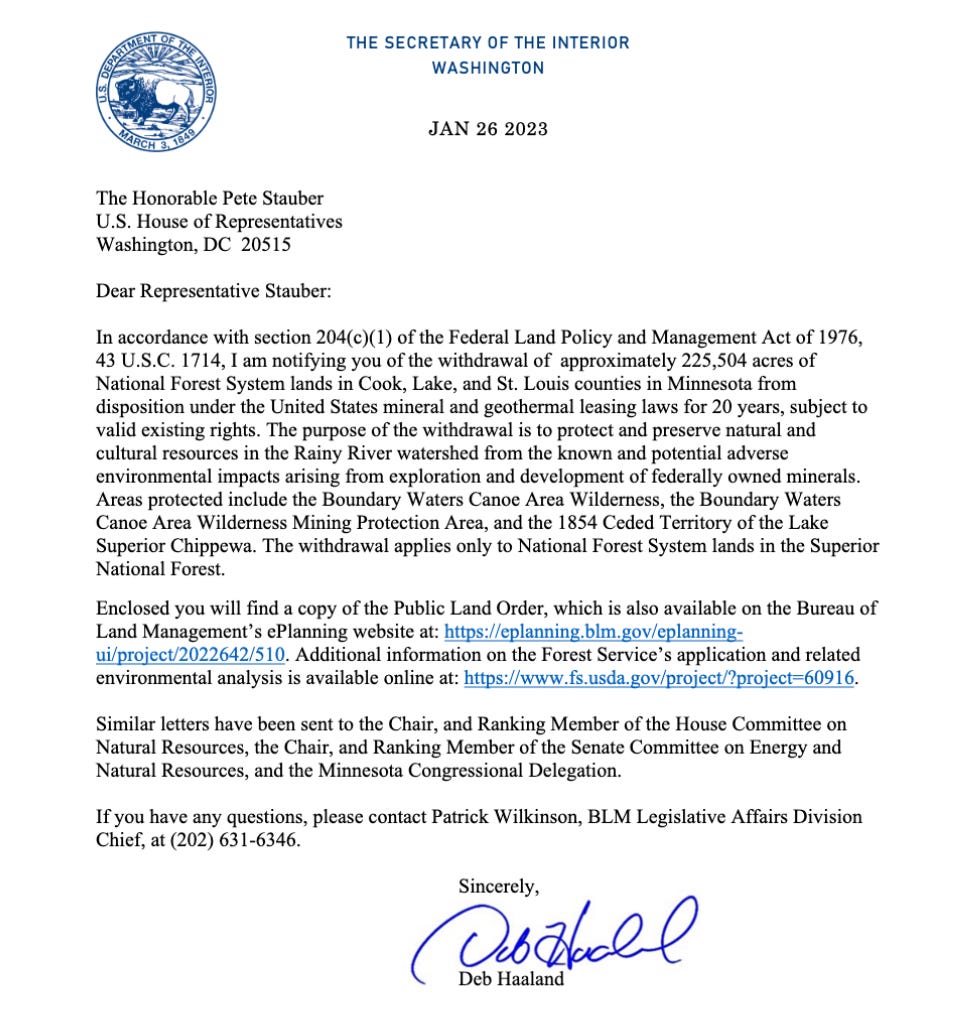
The use of the CRA in this unprecedented manner — to target years-old public lands protections — has disturbed conservationists, who worry that the GOP will use similar maneuvers to target all sorts of long-standing environmental rules, regulations and designations that they oppose. Indeed, Republicans in Congress have already used the CRA to rescind resource management plans on federal lands across the West, and have taken steps to target national monuments in a similar manner.
“This legislative scheme to overturn protections for the Boundary Waters – protections that are supported by science, the law, and the people – is an outrageous attack on one of America’s most iconic and unique landscapes, and must be rejected by Congress,” said Ingrid Lyons, the executive director of Save the Boundary Waters. “Using the Congressional Review Act to attack these protections also creates a reckless precedent that would allow Congress to retroactively target virtually any public land action as a ‘rule.’ If this maneuver succeeds, no established land management decision would be safe.”
Stauber’s office, the House Natural Resources Committee, the Interior Department and Twin Metals did not respond to request for comment.
But it’s not just the Boundary Waters that are under threat from the GOP’s agenda. Conservationists working to protect the wilderness area are themselves being targeted by Stauber and his allies. In December, Stauber and other Republican members of the House Natural Resources Committee sent letters to The Wilderness Society, the Center for Biological Diversity, and Earthjustice accusing them of playing a “backroom role” in Biden’s decision to implement the mining ban and cancel two mining leases that the first Trump administration issued to Twin Metals. Those leases had been the subject of a lawsuit by The Wilderness Society and other environmental groups.
Among Stauber’s allegations is that The Wilderness Society held “private, off-the-books meetings” with high-ranking members of the Biden Interior Department while it was in active litigation over the Twin Metals’ leases. Basing their allegations on a set of public records first obtained by a shadowy Trump-aligned conservative group, Stauber and his Republican colleagues claim the meetings were potentially improper and unethical and amounted to collusion. They demanded the three environmental groups hand over their internal records related to the matter.
In a response to the Committee’s allegations, Kieran Suckling, executive director of the Center for Biological Diversity, highlighted the hypocrisy of Stauber and his allies, noting that lobbyists for Antofagasta and Twin Metals held private meetings with Trump administration officials while the companies were engaged in their own litigation over mining in the Superior National Forest back in 2017.
“As the Committee professes to be very concerned about lobby meetings taking place during active litigation, it should be extremely interested to know that The New York Times and independent researchers have documented at least 18 meetings between Twin Metals and Antofagasta execs and lobbyists with federal employees at DOI, the State Department, and the White House while it was in active litigation challenging the denial of the Twin Metals lease,” wrote Suckling in a response letter to Stauber and his colleagues.
Those meetings included a summer 2017 confab between a Twin Metals’ lobbyist and Kate MacGregor, a political appointee at the Interior Department during Trump’s first term who is now serving as Interior’s Deputy Secretary. Attorneys with one of Twin Metals’ law firms also met with the Interior Department’s solicitor and his team in June 2017. Notably, the House GOP did not seek to investigate those meetings.

The committee’s investigation into Boundary Waters defenders, added Suckling in a statement to Public Domain, is “pure bunk. It is nothing but a poorly-attempted effort to intimidate and scare people and it is not working. It won’t work.”
We’ve seen dishonest, corrupt and downright stupid administrations in the USA but this is a unique and nasty blend of chaos, destruction, cruelty and bottomless greed.
Thank you. This is a tragic situation…😢