


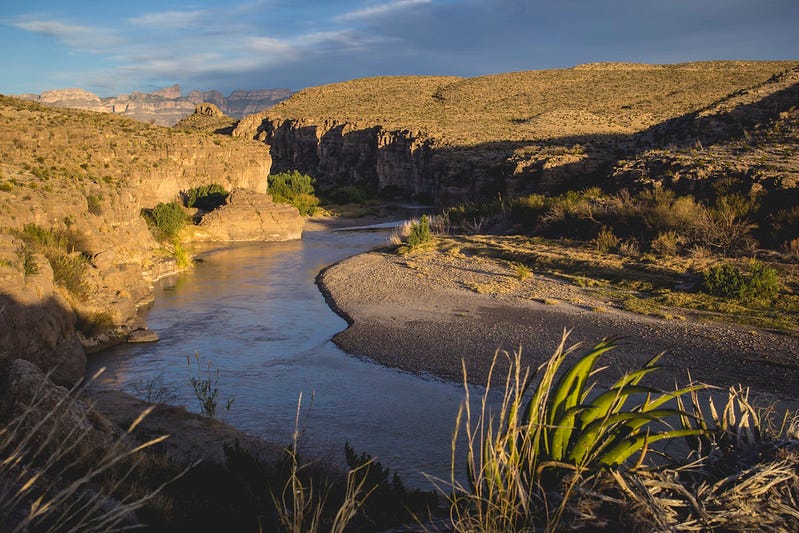
The Trump administration has paused all border barrier construction work at Big Bend National Park, after a flurry of videos showing bulldozers marring the protected landscape drove a furious backlash.
The move, announced Monday by Customs and Border Protection Commissioner Rodney Scott, comes amid growing public outrage over the Trump administration’s fast-paced efforts to tarnish the pristine park with border security infrastructure that local leaders from both parties view as unnecessary in an area where unlawful crossings are rare and steep cliffs provide a natural barrier to entry. Several groups have filed lawsuits aimed at stopping the construction.
In a post to social media announcing the pause, Scott said he would visit Big Bend to “conduct a personal, on-the-ground evaluation.”
“CBP is firmly committed to protecting America, and that includes our national treasures like Big Bend National Park (BBNP),” he wrote. “We know the current and predictable national security threats and they are real. Now over the next couple of days, I will join a small team to evaluate the terrain and listen to local leadership, community members and stakeholders to ensure that we secure our borders while simultaneously protecting BBNP for generations to come.”

In recent days, advocates have documented bulldozers and other heavy equipment tearing up land — including at the mouth of the park’s famed Santa Elena Canyon, an iconic area where the Rio Grande is flanked by cliffs towering some 1,500 feet overhead. CBP did not announce the construction ahead of time, despite the fact that its parent agency, the Department of Homeland Security, had agreed in a federal lawsuit to provide at least 30 days notice before breaking ground there.
Construction activity at Big Bend National Park. Footage Taken by Natalie Newman.
CBP initially denied that construction was taking place, saying earlier this month that bulldozers filmed by activists were re-grading storm-damaged roads. Scott acknowledged last week that the heavy machinery at the park was conducting work related to the border barrier expansion, but said in a statement that “what people are seeing right now is survey and design work—NOT construction of a wall through the park.”
Former Big Bend National Park Superintendent Bob Krumenaker told Public Domain that he was “encouraged, but also wary” of the announcement.
“When he says construction activity is ending, I hope he means all activity with heavy equipment is ending,” said Krumenaker, who now chairs the advocacy group Keep Big Bend Wild. “It’s difficult to trust the words of CBP. We’re hopeful that they’re honest and we can trust them, but it’s too early to know.”
The sudden pause “proves how much non-partisan public pressure is mounting in West Texas and across America to stop the irreversible destruction unfolding in this crown jewel national park,” Laiken Jordahl, a public lands advocate with the Center for Biological Diversity who has been closely tracking construction activity in and around Big Bend, said in a statement.
“It’s welcome news, but construction at Big Bend is likely to resume at any moment,” Jordahl said. “We’re not resting until these contracts are canceled, these workers are sent packing, the waivers are rescinded and every wall plan for the greater Big Bend region is scrapped for good.”
Trump’s “big, beautiful” spending bill passed by the Republican-dominated Congress last year contained a whopping $46.5 billion to expand the wall along the U.S.-Mexico border. Since February, CBP has signaled that it planned to use some of those funds to expand it’s “smart wall” in the Big Bend region, a roughly 500-mile stretch along the Rio Grande that includes Big Bend National Park, Big Bend Ranch State Park, and Black Gap Wildlife Management Area.
CBP’s smart wall map at first appeared to indicate the agency had planned to erect 30-foot steel bollard wall across much of the length of the park. Facing widespread backlash from park users, business leaders and a bipartisan group of local sheriffs, CBP limited its publicized plans to 17 miles of non-contiguous vehicle barriers of up to six feet tall, along with some 200 miles of patrol roads. Southwest Valley Contractors of New Mexico secured a $1.7 billion contract in May to build border infrastructure, including the planned vehicle barriers and roads in the park.
But public land advocates still recoil at the thought of plowing up ground, obstructing river access and turning an area prized for its remoteness into a construction site.
There is “absolutely no risk of vehicles crossing the border,” Krumenaker, the former superintendent, told Public Domain earlier this summer. “It’s senseless destruction.”
Talarico will win with this massive mistake by the Trump administration. He is touring west Texas and talking to people. Nobody wants this foolishness. On other areas of the border in Arizona, they are cutting down beloved cottonwoods and the one left standing is occupied ala Julia Butterfly!!!
Better late than never, I guess ...