


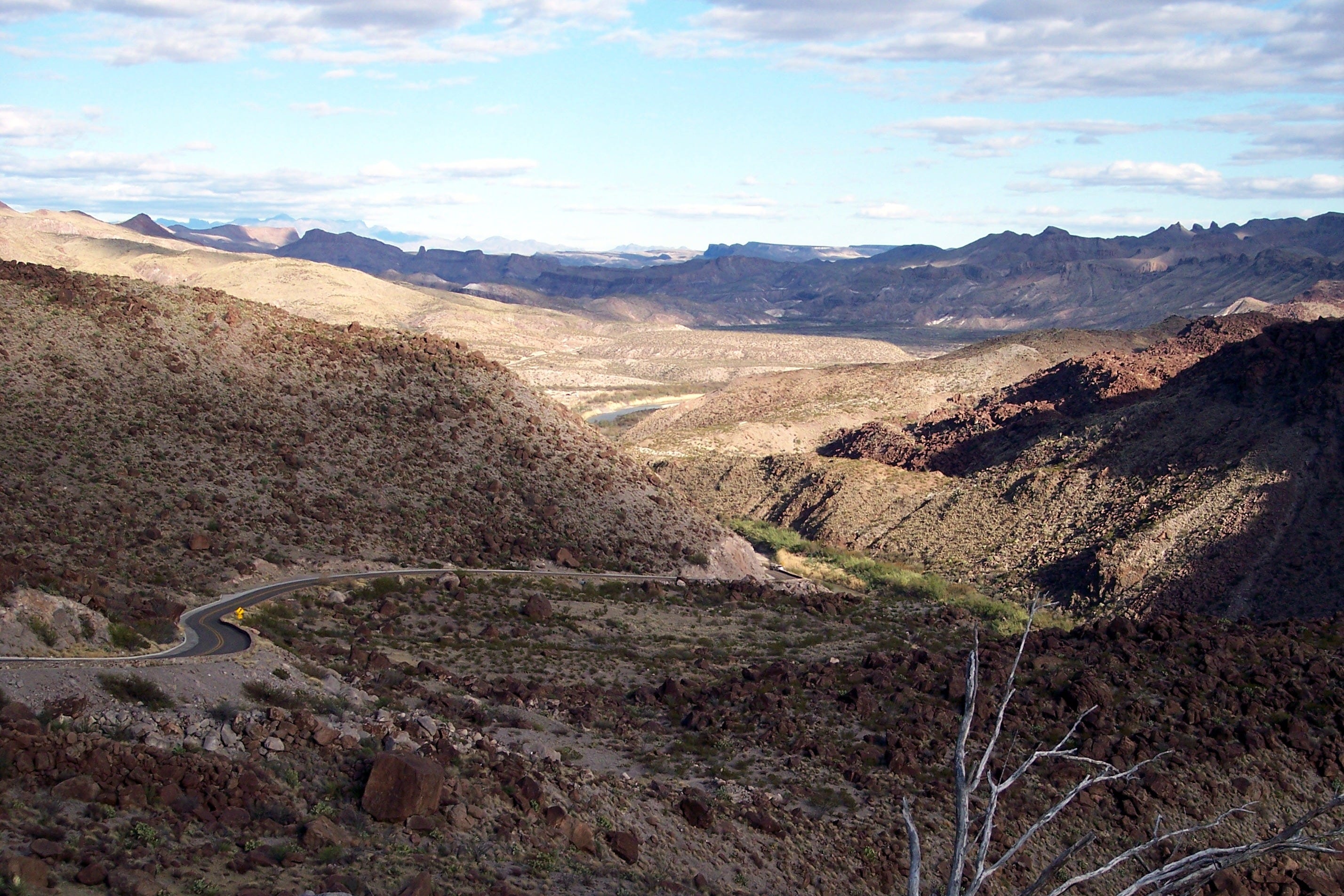

The Trump administration plans to resume border security construction at Big Bend National Park in coming weeks, according to a notice submitted in federal court Tuesday.
The resumption of construction re-ignites an ongoing battle over the future of what is widely viewed as the most pristine protected landscape in Texas — an 800,000-acre stretch of Chihuahuan Desert that encompasses the entire Chisos Mountain range and more than 100 miles of Rio Grande river frontage.
Customs and Border Protection “is actively considering adjustments” to its current construction plans that “would reduce its scope and avoid or minimize potential impacts” based on feedback from the National Park Service and other stakeholders, the agency said in the notice.
The agency will finalize its plans the first week of October. It will take “likely several weeks” after settling on new plans for CBP to resume bulldozing and other “ground-disturbing activities,” the notice says.
CBP has repeatedly changed its plans since February, when it quietly updated its online “smart wall” map to indicate that it would build a 30-foot steel bollard wall across much of the park, including some of its most scenic attractions.
The agency has since scaled back its ambitions. Its current plans call for 17 miles of non-contiguous vehicle barriers measuring roughly six feet tall, along with some 200 miles of patrol roads.
Those plans have sparked furious opposition from local politicians of both parties and major protests from public land advocates and park enthusiasts. The backlash peaked last month, as footage captured by photographer Natalie Newman showed bulldozers plowing up the park’s ground to prepare for new roads.
Activists, local leaders and business owners remain hostile to any new security construction at all, viewing it as an unnecessary marring of a wild landscape whose virtues — stargazing, backpacking and multiday river floats — depend on federal protection. Outdoor recreation and guiding at Big Bend serve as a major economic engine in a sparsely populated and isolated region.
“Building in Big Bend would be mutilating an extraordinary landscape at a massive cost to the taxpayer — with little ultimate benefit,” Emily Thompson, the executive director of the Coalition to Protect America’s National Parks, wrote in a statement.
CBP faces several lawsuits challenging its authority to waive federal laws to speed border barrier construction in the Big Bend region. The agency filed its notice Tuesday in a federal lawsuit brought by the Friends of the Ruidosa Church, river guide Billy Miller and the Center for Biological Diversity.
“It’s pretty shocking that they would choose to lift this pause when they have seen the widespread fury that’s been unleashed across all of Texas based on the damage they’ve already done to Big Bend,” said Laiken Jordahl, a public land advocate with the Center for Biological Diversity. “It shows the agency is answering to these billionaire contractors and not to the American people.”
U.S. District Judge Kathleen Cardone will hear evidence on Friday in El Paso to assess whether to block CBP from continuing to build border security infrastructure in the area while the lawsuit proceeds.
The Republican-dominated Congress included $46.5 billion to expand the border wall in last year’s sprawling spending bill. The largest unwalled stretch of the U.S.-Mexico border lies in what CBP calls the “Big Bend” sector in west Texas. The Big Bend sector has long seen the fewest annual apprehensions for unauthorized crossings, despite the fact that it is the longest sector, encompassing more than 500 miles along the Rio Grande.
Federal law shields Big Bend National Park from development. But in June, Homeland Security Secretary Markwayne Mullin signed a waiver exempting a stretch of the Texas border that includes the park from protections contained in dozens of federal laws.
Public land advocates traveled to Washington last week to press members of Congress from both parties to etch further protections for Big Bend National Park into federal law. Former Big Bend Superintendent Bob Krumenaker said he was confident that a bipartisan group of federal lawmakers would move to protect Big Bend from destructive border security infrastructure, either by sticking an amendment into the next appropriations bill in December or filing stand-alone legislation to beef up protections.
“There’s universal concern that crosses party lines about what CBP is doing at Big Bend National Park,” said Krumenaker, who now chairs the advocacy group Keep Big Bend Wild.
CBP spokespeople initially denied that the agency was building border security infrastructure last month, saying that bulldozers filmed by activists were grading storm-damaged roads. Days later, CBP acknowledged that the agency was building new roads. Then, CBP Commissioner Rodney Scott called for a temporary pause to go visit the area and discuss the construction with local stakeholders.
What could have possible changed since the last time he was told “no”?