


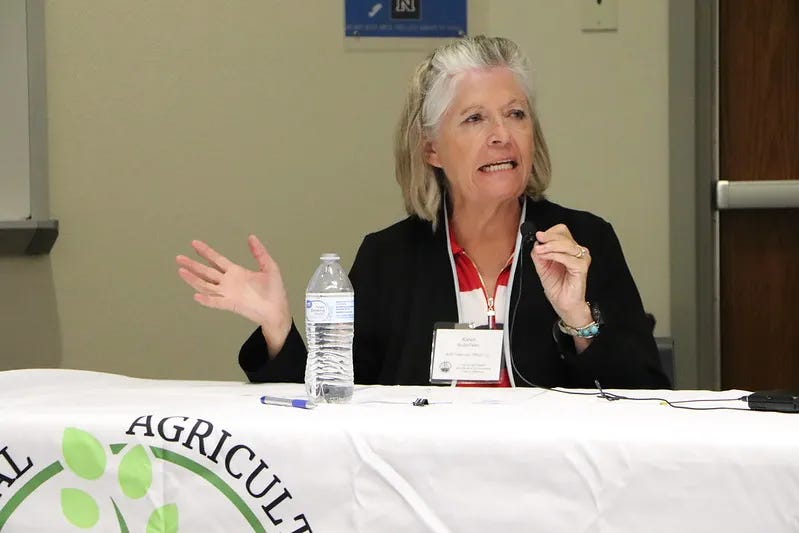
UPDATE: Ethics officials at President Donald Trump’s Interior Department granted Karen Budd-Falen, the agency’s No. 3 official, a waiver on March 11 — the very day that Public Domain inquired about her recent work on grazing issues — that provides her wide latitude to work on grazing policy and permitting, despite her family’s vast personal holdings in the public lands grazing industry.
The waiver is a stunning reversal from her stint at Interior during the first Trump administration, when she was barred from working on or even discussing federal grazing matters.
“These waivers will allow you to participate in particular matters of general applicability that may have a direct and predictable effect on your direct and imputed financial interests in the Budd-Falen Ranch and Cattle Interests or the BLM grazing permits that are either attached to any of the Budd-Falen Ranch and Cattle Interests,” reads the waiver, issued by Heather Gottry, director of Interior’s ethics office. “These waivers are being issued because of the level of experience and expertise necessary to perform the position of Associate Deputy Secretary and reflects the determination by Department leadership that your background, leadership, and skill set are critical to the work of the Department.”
The waiver goes on to note that Budd-Falen advised ethics officials that recusing herself from grazing matters had become restrictive.
“You have advised us that, although recusal was initially successful and workable, it is limiting your ability to fully engage in policy discussions related to grazing permits and other relatable policies,” Gottry wrote. “Further, recusal has become overly burdensome and deprives the Department of your knowledge and expertise.”
As detailed below, Public Domain reached out to Interior last week about Budd-Falen’s recent involvement in an ongoing dispute over cattle grazing at Point Reyes National Seashore and the agency’s recent overhaul of the National Environmental Policy Act that stands to benefit public land ranchers across the country. The waiver first appeared on the U.S. Office of Government Ethics disclosure database on March 12, but is dated March 11 — the day Public Domain sent its inquiry to Interior. Interior’s ethics office provided the document to Public Domain on Friday afternoon, March 20, 2026, noting that it was releasing “requested records to include the most recent documents in our possession that were received more than 30 days ago.”
Notably, the waiver does not appear to be retroactive to cover Budd-Falen’s work on grazing issues in recent months. Instead, it contains foward-looking language like “will permit your participation…”
The Interior Department did not immediately response to Public Domain’s request for comment.

Public Domain will be digging deeper into the document in the coming days. Check back for updates.
PREVIOUSLY: When self-proclaimed “cowboy lawyer” and rancher Karen Budd-Falen stepped into the first Trump administration in 2018 as a high-ranking legal official at the Interior Department, she promptly signed ethics documents that barred her from working on or even discussing grazing issues.
“I will recuse myself from any discussion of grazing matters or the Department’s process for issuing grazing permits for the duration of my appointment,” reads a disqualification statement that accompanied her ethics recusal, both of which are dated Nov. 5, 2018.
Budd-Falen is now back at the Interior Department, serving as associate deputy secretary, the agency’s third highest-ranking position. While her Interior work portfolio is broader than during her first stint in the Trump administration, her potential conflicts of interest tied to ranching remain largely the same, as her 2025 financial disclosure details.
Yet Budd-Falen has been actively working on grazing-related issues since returning to Interior, including a longstanding dispute over beef and dairy cows at Point Reyes National Seashore and the agency’s recent overhaul of the National Environmental Policy Act that stands to benefit public land ranchers across the country.
As a private attorney, Budd-Falen represented numerous ranching interests in fights against environmental regulations and the very public land management agencies she now oversees. Budd-Falen and her husband have stakes in multiple ranching operations, some of which maintain federal permits to graze cattle on public lands. One of those ranches is at the center of a lucrative financial deal that Budd-Falen’s husband struck with the developer of a Nevada lithium mine — a deal that Public Domain first revealed and that has triggered calls for an investigation.
There is no clear evidence that Budd-Falen has signed an updated ethics recusal covering her current tenure. And if there is an updated recusal that allows for her to work on grazing policy, the question is why — again, the ranching assets listed in her most recent financial disclosure closely mirror those she had during the first Trump term.
A batch of documents that Interior released late last month to the Center for Western Priorities, a Colorado-based conservation group, included only her 2018 ethics filings, standard ethics guidance materials that she received early in her current tenure and a “draft”, blacked out list of her recent legal clients.
The Interior Department has repeatedly ignored Public Domain’s questions about whether Budd-Falen’s 2018 ethics documents are still binding, but said last month that she filed all the appropriate paperwork and that her relevant ethics filings “have been supplied.” On March 11, Public Domain asked Interior about Budd-Falen’s involvement in grazing-related issues since returning to the department, given the clear language in her 2018 ethics filings. Again, an Interior spokesperson did not respond. The following day, a “conflict of interest waiver” for Budd-Falen suddenly appeared in the U.S. Office of Government Ethics disclosure database. Public Domain has requested but not yet obtained that document, and Interior did not respond to questions about what the waiver covers.
Patrick Kelly, the Montana and Washington state director for Western Watersheds Project, an environmental group, told Public Domain that “if Budd-Falen is indeed still bound by her 2018 ethics recusal, then her recent conduct plainly violates it.”
“That agreement barred her from participating in matters involving federal grazing because she refused to divest her own grazing interests, and no replacement ethics disclosure has surfaced suggesting the restriction has been lifted,” he said. “Her recent and very public involvement in grazing disputes—including the ranching settlement at Point Reyes—would place her squarely in violation of the prohibition against participating in grazing-related discussions. This represents a glaring conflict of interest and raises profound questions about whether federal public-lands decisions are being shaped in the public interest or at the behest of the livestock industry.”
Budd-Falen was already facing mounting scrutiny after Public Domain and High Country News first revealed in December her deep financial ties to a massive Nevada lithium mine that was approved during Trump’s first term. In 2018, shortly after she joined the first Trump administration, her husband sold water rights from Home Ranch, LLC, one of the family’s ranching operations, to Lithium Nevada Corp., the developer of the controversial Thacker Pass mine. Budd-Falen never publicly disclosed that water sale in her annual financial disclosure forms. And while she received a waiver in 2018 to retain her financial interest in Home Ranch and other family ranching assets, she agreed not to participate in matters that involve or could financially benefit those operations. House Democrats have called on Interior’s internal watchdog to investigate the matter.
In its press release last month announcing its NEPA reforms, the Trump Interior Department noted that the changes will “reduce delays and costs for projects across public lands, including energy development, critical minerals, livestock grazing approvals” and other activities on the federal estate. Budd-Falen is quoted in the announcement, describing the Trump administration’s action as “a decisive step toward fixing a broken permitting system.”
“Interior is restoring NEPA to what Congress intended — a procedural law that informs decisions, not a regulatory maze that delays them for years,” she said. “These reforms will help unleash American energy, strengthen rural communities and deliver real results faster for the American people.”
Budd-Falen has also waded into a longstanding dispute over grazing at Point Reyes National Seashore in California. In January, in the waning days of the Biden administration, environmentalists and ranchers struck an agreement to end most grazing at the preserve, with affected ranchers receiving compensation. But as E&E News reported in October, Health and Human Services Secretary Robert F. Kennedy Jr. intervened in an apparent effort to upend the deal. Interior Secretary Doug Burgum later tapped Budd-Falen to “broker a Point Reyes solution,” according to the publication.
Earlier this month, Budd-Falen traveled to Point Reyes to meet with stakeholders, including park leaders, environmentalists, affected ranchers and “a motley crew of ranching advocates who have spent over a year attempting to unravel the deal,” The Point Reyes Light reported.
Craig Holman, a government affairs lobbyist and ethics expert at the progressive watchdog group Public Citizen, said ethics rules carry over if someone exits and then reenters government, until they are specifically changed or nullified. He stressed that the main problem isn’t Budd-Falen’s ethics recusal, but rather the lack of enforcement.
“Literally, all the agencies charged with enforcing these ethics rules have been dominated by Trump loyalists who do not believe in the rules,” he said. “Trump personally finds ethics restrictions as obstacles to his interests and has revoked the presidential ethics executive orders. More importantly, he has neutered the very agencies charged with enforcing governmental ethics.”
Thank you so much for the coverage.
she needs to resign … too many questions and questionable actions