


Last year, Montana’s Republican congressional delegation emerged as an 11th-hour bulwark against the GOP’s most brazenly anti-public lands agenda. Led by U.S. Rep. Ryan Zinke, Montana conservatives played a key role in blocking schemes from Utah Sen. Mike Lee (R) and other Republicans to sell off as much as 3.2 millions of acres of federal land in the American West.
Montana Republicans have worked for years to cast themselves as public land defenders, even as their state party’s official platform called for turning federal lands within Montana’s border over to state control — a move that public land advocates and conservationists warn would cost the state billions and ultimately lead to them being sold or privatized.
Lee’s failed and widely condemned proposal provided a unique opportunity for the Montana GOP to shift course and align itself more closely with Montana voters. A whopping 84% of Montanans support banning the sale or transfer of public lands, according to an April poll commissioned by the University of Montana.
Instead, the Montana GOP doubled down, adopting an updated platform this summer that maintains support for public land transfers, but with new language about the importance of public access.
“Support transferring federally managed lands to the state with a transition plan and continued public access,” reads the updated document, which Montana Republicans adopted at their biennial platform convention in Missoula in June. (The previous iteration called for “relinquishing federally managed public lands to the states in order to secure statehood equality and provide for better management of public lands.”)
That new language serves as a kind of Trojan horse, according to Alex Blackmer, a spokesperson for Wild Montana Action Fund.
“Including vague references to a ‘transition plan’ and ‘continued access’ in the platform is a way to make support for selling off public lands more palatable,” Blackmer wrote in an email to Public Domain. “It’s an old trick.”
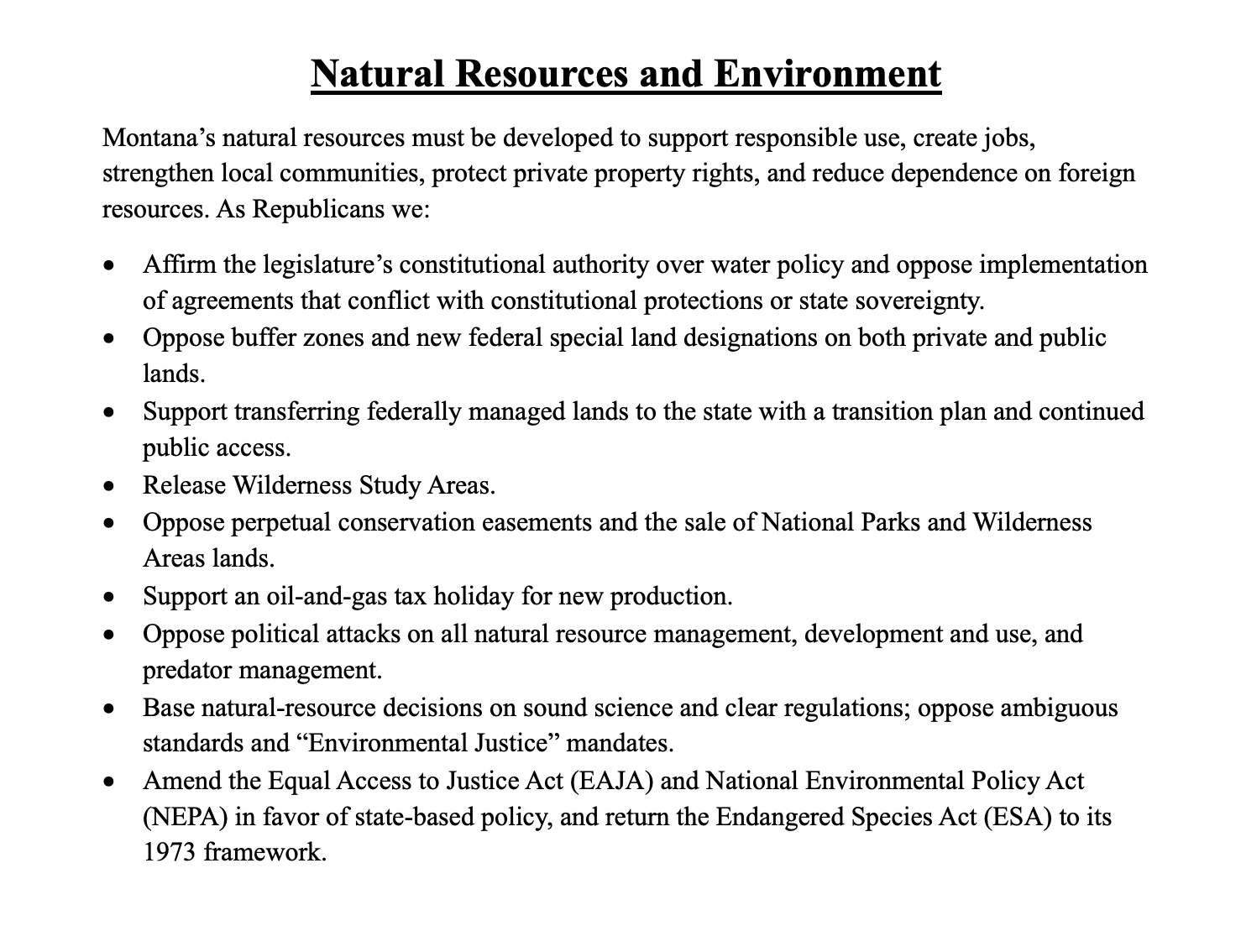
The updated document — a broad set of GOP policy priorities — also calls on Republican lawmakers to “oppose perpetual conservation easements and the sale of National Parks and Wilderness Areas lands.”
Taken together, the language seemingly makes clear that members of the GOP are expected to support large-scale land transfers while remaining open to the possibility of selling federal lands that Congress has not designated as national parks or wilderness areas. If the party opposed the sale of any and all federal lands, it could have stated that position explicitly — as the Montana Democratic Party did in its recently updated platform.
“It sure sounds like the only reason to explicitly mention those two is that you’re OK with selling off other types of public land, doesn’t it?” Blackmer said. “Either you’re opposed to selling off public lands or you’re not.”
It is unclear if any Republican Party delegates objected to the new platform language, either by voting against it or offering an amendment to the land transfer position. The Montana GOP told Public Domain in an email statement that it has “no record of” delegates debating the public lands policy statements at the June conference.
“They came out of the Natural Resources ‘plank’ committee to the full convention. They were not debated on the floor before passage,” Ashley Bianco, the political director of the Montana Republican Party, wrote in a statement. “The delegates generally agreed that careful planning must occur before any transfer of (non Park or Wilderness) federal lands to the state, and preservation of public access are essential policy priorities in any decisions regarding public lands.”
Bianco did not provide a list of members of the national resources committee or minutes from the conference. She also did not respond when asked if any delegates voted against the party platform.
According to the Montana GOP’s bylaws, also adopted in June, delegates to the recent platform convention included Republican incumbents of national and statewide offices, as well as Republicans nominated during the June 2 primary elections. Those would include every member of the Montana Republican congressional delegation — Sens. Steve Daines and Tim Sheehy and Reps. Zinke and Troy Downing — as well as Kurt Alme and Aaron Flint, the Trump-endorsed Republicans running to replace Daines and Zinke, respectively. Neither Daines nor Zinke are seeking reelection.
Public Domain reached out to all six aforementioned Republicans to ask where they stand on the platform’s public lands language. Downing was the only one who responded. In an emailed statement, he said he has “consistently opposed sweeping efforts to transfer or sell off our public lands,” including the divestment mandate that was initially included in last year’s “Big, Beautiful” budget bill.
“Montanans expect continued access to the lands they hunt, fish, recreate on, and rely on. Any policy affecting public lands should protect that access and keep these lands in public hands,” Downing said. “As for the state party platform, I can speak to my own position and record. I do not support selling off Montana’s public lands, and I will continue working to protect public access.”
Downing’s office did not respond to follow-up questions about whether he or any other party delegates voted against or otherwise objected to the platform’s pro-transfer language.
The Montana GOP’s continued support for federal public lands being transferred to state control comes as Montana Republicans in Congress are still receiving accolades for standing against last year’s GOP sell-off attempts.
Last month, the Rocky Mountain Elk Foundation presented Zinke with its Excellence in Advocacy Award. In its press release announcing the award, RMEF noted that the outgoing Congressman “was outspoken in opposing Senate language in the ‘One Big Beautiful Bill Act’ that would have sold off or transferred federal public lands and played a leading role in having the sell-off language removed from the bill.”


In 2016, Zinke made national headlines when he resigned as a delegate to the Republican National Convention over its support for handing federal lands over to states. Yet it is unclear if he supported or opposed the new state party platform; his office did not respond to requests for comment for this story.
In recent elections, Montana conservatives have been forced to walk a fine line on the issue, voicing vague support for the federal estate — “public lands in public hands” has become a favorite talking point — without directly challenging the party line. Critics have accused Republicans in the state of posing a threat to America’s public lands and of trying to hide their support of public land transfers or sales.
Sheehy, for example, called for federal lands to be “turned over to state agencies, or even counties” in a podcast interview while on the Senate campaign trail in late 2023, then spent months working to distance himself from those comments and vowing to oppose any effort to liquidate federal lands.
Similarly, Flint, a longtime conservative radio host, is campaigning for Congress on a pledge to defend public lands, despite a long history of voicing support for transferring federal lands to state control, as Public Domain previously reported. Alme is doing the same, while getting a boost from a super PAC that has a history of funneling money to land transfer and sale advocates.
The updated party platform and the Montana GOP’s lack of transparency around it are likely to only further complicate things for Flint and Alme between now and the November election. A Center for Western Priorities analysis last month concluded that “selling off public lands is a third rail for Mountain West voters.” Among other things, it cited a January survey that found 84% of Montana voters want to see public lands protected and kept in public hands, compared to just 6% who want to see them sold or transferred to states or private interests.
I am thinking that the Montana GOP is so blatantly opposing their voters THAT—- the republicans already know the outcome of the midterms
Meaning they have rigged the elections - or were told a TRUMPF plan of action- that will guarantee Democrats will never get elected at the midterms …
Fucking hell Montana public land defines you as a state