


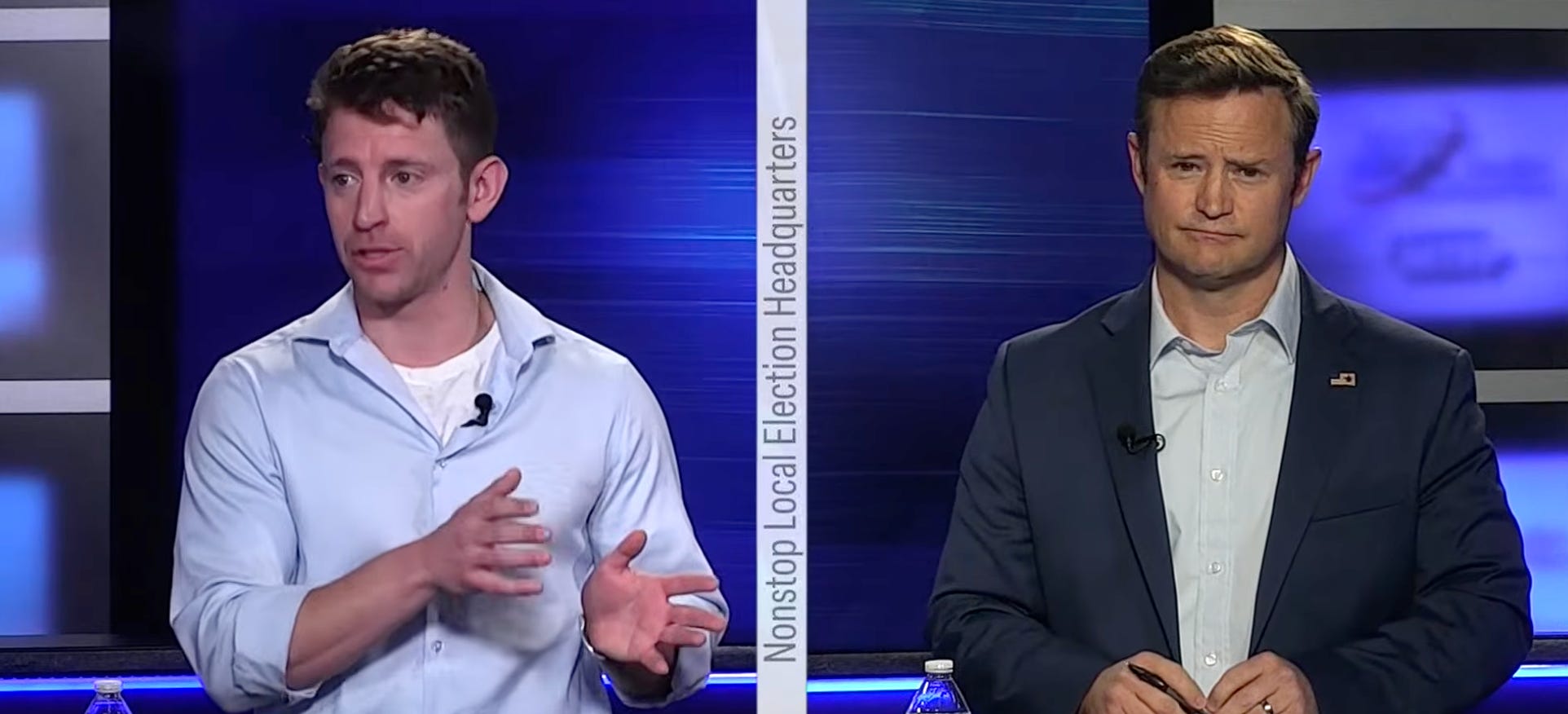
The two Montana Republicans vying to replace outgoing Rep. Ryan Zinke and Sen. Steve Daines in upcoming midterms made their fullest comments yet on public land issues during a series of debates over the last week.
But their answers remained clipped and cautious, raising questions about whether Montana Republicans will remain a bulwark against the GOP’s increasingly aggressive attempts to liquidate federal public lands.
Democratic and Independent candidates running for those seats have taken strong positions, pledging to preserve federal public land protections if elected.
As in past Montana elections, public lands have emerged as a key issue in the upcoming midterms — largely due to recent, failed schemes by Utah Sen. Mike Lee and other Republicans to sell off as many as 3.2 millions of acres of federal land in the American West. Montana’s Republican congressional delegation, including Zinke and Daines, was widely credited with helping block those efforts.
But Zinke and Daines announced in March they would not seek reelection, making the races for their seats among the most consequential for the future of public lands.
During two debates in less than a week, Aaron Flint, the Trump-endorsed Republican running to replace Zinke, twice promised that he will fight to “keep public lands in public hands.”
Both times, Sam Forstag, the Democratic candidate, dismissed Flint’s words as hollow.
“‘Public lands in public hands’ — That’s the same thing we hear from every politician,” Forstag, a progressive Forest Service smokejumper, said during a Friday debate in Bozeman. “It means nothing. We need action.”
In Flint’s case, it’s worth questioning what he means when he says “in public hands.” As Public Domain previously reported, the Army veteran and longtime conservative radio host has a long history of voicing support for transferring federal lands to state control — a move that would strip them from the broader public’s hands and could ultimately lead to privatization.
An April poll commissioned by the University of Montana found that a whopping 84% of Montanans support banning the sale or transfer of public lands. Yet at its biennial platform convention in June, the Montana Republican Party adopted an updated party platform that not only maintained support for public land transfers, but seemingly left the door open to selling federal lands that are not national parks or wilderness areas, as Public Domain reported.
At a debate on Sunday in Bozeman, Montana Senate hopefuls were asked about their vision for managing federal public lands in Montana.
Independent candidate Seth Bodnar called public lands “sacred” and condemned recent Republican attacks on federal lands and the agencies that manage them.
“We need a U.S. senator who’s going to stand up and fight like hell to defend our public lands, not be the servant of Mike Lee down in Utah, who’s going to do everything he can within the Republican Party to sell off our public lands,” Bodnar said.
“It’s easy to give lip-service talking about public lands. It’s hard to stand up and actually fight for them,” he added. “We can hear the Republican on this stage talk about it, but the fact is we’ve seen a relentless push from the Republican Party [and] Mike Lee. We’ve seen it in the Republican Party platform to transfer public lands to the states, which means selling them off.”
Kurt Alme, the Trump-endorsed Republican candidate, stuck close to a favorite Republican talking point: “I will always fight to keep our public lands in public hands. And I’ll fight against anyone who tries to sell them off.” As Public Domain previously reported, a super PAC with ties to the anti-federal land movement is helping boost Alme’s image as a public lands champion.
Democrat Alani Bankhead called Alme’s comment “hilarious.”
“He’s the one who said he was Trump’s guy and Trump’s the one who is actually opening up our public lands to exploitation,” Backhead said, pointing to the Trump administration’s push for AI data centers to be developed on federal lands.
At the two recent House debates, public lands came up during broader discussions about rising costs and the buildout of AI data centers.
During a heated debate Tuesday in Missoula, Flint worked to cast Forstag as a “far-left” outsider and accused him of being aligned with people who he claims “destroyed our timber industry, destroyed our public lands and destroyed big game hunting opportunities here in western Montana.” In an effort to prove his public land bonafides, Flint touted endorsements from a number of gun advocacy and shooting sports groups.
“I will fight to protect public lands, not only from data centers but from far-left extremists like my opponent,” Flint said.
Forstag repeatedly pressed Flint to join him in pledging to oppose any data center construction on public lands, but Flint made no such commitment. And Forstag said that while Flint was “running his mouth on the radio” for the last eight years, he was “running a chainsaw actually protecting our public lands.”
In his closing statement Tuesday, Forstag told voters that Montanans “deserve a congressperson who stands up for working people, who stands up for our public lands, not just with slogans but with actions.” Along with being able to afford a home and access to healthcare, Montanans “ought to be able to go hunt or hike or fish on our public lands without worrying that they’re going to be sold out from underneath us to corporations,” he said.
As usual, a good summary of the debates. Thanks!