


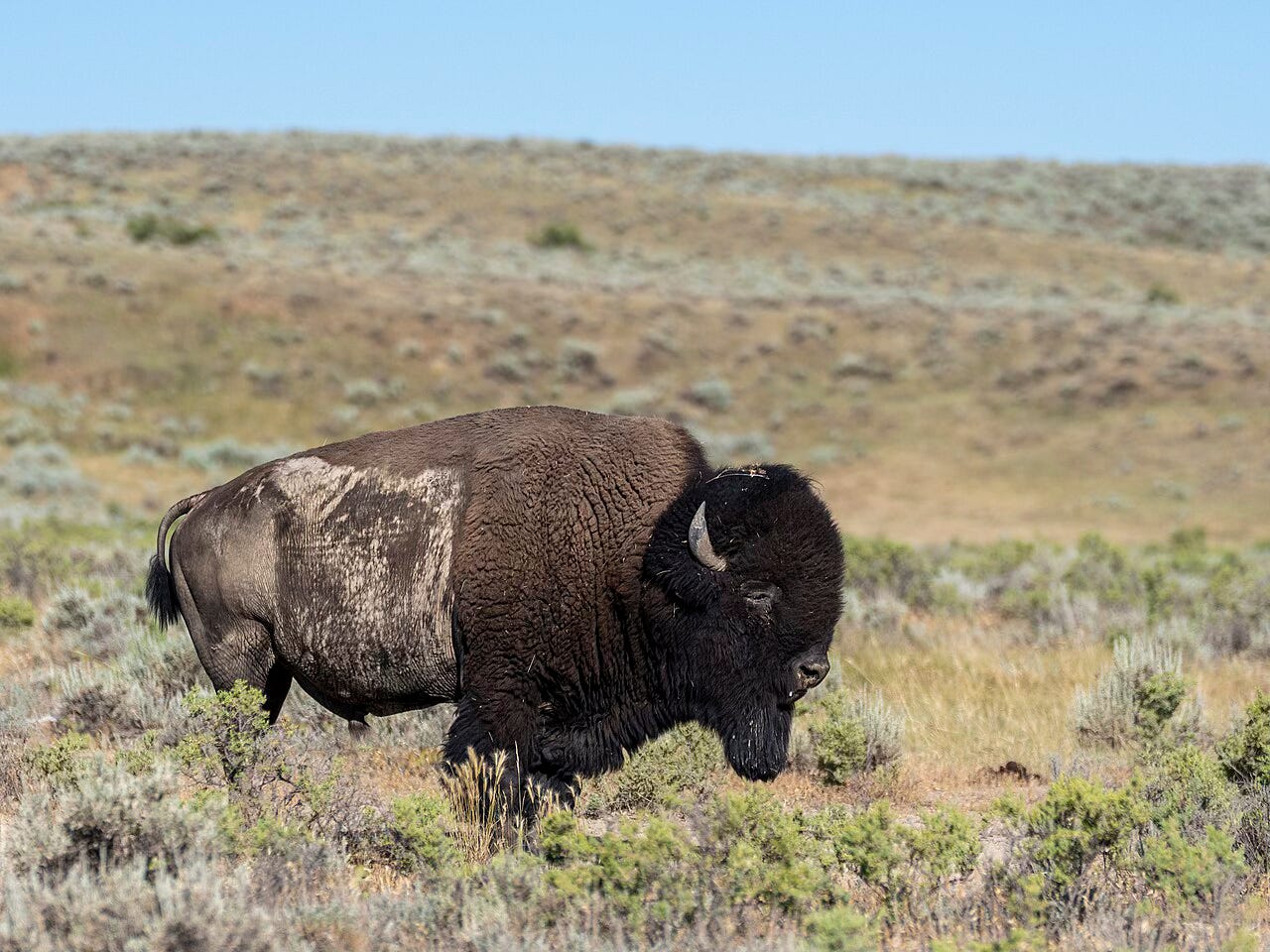

A federal judge on Friday temporarily blocked the Trump administration’s efforts to evict hundreds of bison from public lands in Montana.
The preliminary injunction and temporary restraining order, issued by U.S. District Judge Brian Morris, marks a win for American Prairie, a Montana-based conservation organization that for more than two decades has worked to restore bison to public and private lands in the state.
“Bison belong on this landscape, and today’s ruling gives them a chance to stay,” American Prairie CEO Alison Fox said in a statement. “For more than 20 years, our bison have grazed these lands under federal authorization and without grazing violations. The court recognized the concrete harm that removing them would cause, not just to our work, but to our Tribal partners and the broader effort to return bison to their native home.”
The Bureau of Land Management withdrew American Prairie’s permits to graze buffalo on federal public lands earlier this year, arguing that the animals amounted to wildlife rather than “production-oriented” livestock. A few days later, BLM issued new grazing regulations that could block future permittees from grazing buffalo on federal public land.
American Prairie sued last month to challenge the BLM’s cancellation of its bison grazing authorizations. In his order, Morris indicated that BLM’s decision to exclude American Prairie’s bison from federal grazing lands was likely “arbitrary, capricious, an abuse of discretion, and otherwise not in accordance with the law.”
The state of Montana classifies American Prairie’s buffalo as livestock and they are confined to specific pastures, tagged for identification and monitored for disease, Morris’s ruling notes. And though American Prairie manages its buffalo as a conservation herd, many of its animals become meat either through donation to other conservation herds or through a public hunting program that has produced approximately 75,000 pounds of meat from some 370 bison since 2016.
“No statutory language or judicial precedent exists that requires a livestock operation to focus exclusively on production and entirely ignore conservation, range improvement, preservation, or other values,” Morris wrote in his order.
An Interior Department spokesperson declined to address the details of ongoing litigation, but wrote in an email that BLM’s decision “was firmly grounded in federal law and a thorough review of the administrative record.”
“The Department and BLM remain committed to administering public lands in accordance with the law and are confident in the legal and factual basis for its decision,” the spokesperson wrote.
BLM’s withdrawal of American Prairie’s permits marked a major reversal of federal policy. American Prairie secured its first permit to graze buffalo on federal public land back in 2005.
Morris’s ruling does not extend to the Bureau of Land Management’s new grazing regulations. But he noted that “BLM’s shift in interpretation comes after nearly two decades of practice applying the statute in another manner.”
The judge’s order is a setback for Interior Secretary Doug Burgum, who, in an unusual move, personally intervened last year to facilitate the cancellation of American Prairie’s bison grazing permits. As Public Domain previously reported, Burgum’s actions were a direct policy win for cattle ranching groups in Montana who oppose the presence of American Prairie’s bison on federal grazing lands.
Several of these groups, including the Montana Stockgrowers Association, or MSA, were the former legal clients of Karen Budd-Falen, a long-time conservative lawyer and rancher who is now a top Burgum aide and has been engulfed in ethics scandals. Before joining the second Trump administration, Budd-Falen personally represented the MSA in a challenge to American Prairie’s bison grazing permits.
The ruling on Friday only applies to the three federal grazing allotments where American Prairie currently grazes buffalo, though the organization had permission to graze buffalo on six allotments before BLM changed its policy. The order will preserve the status quo until American Prairie’s lawsuit is fully heard, Morris wrote.
BLM has long fought anything good for the lands it oversees.
Cattle Ranchers & the Lumber Industry are diligent in keeping legislation their way.
This ruling is a wonderful surprise.
“The Department and BLM remain committed to administering public lands in accordance with the law..." If those words were in fact true, then federal grasslands and forests would be in much improved ecological condition than they presently are. American can thank cows (i.e., "production-oriented livestock") for those degraded conditions. The only boss that the federal agencies answer to are the cattlemen's associations and the logging industries.
Big win for justice and American Prairie!