


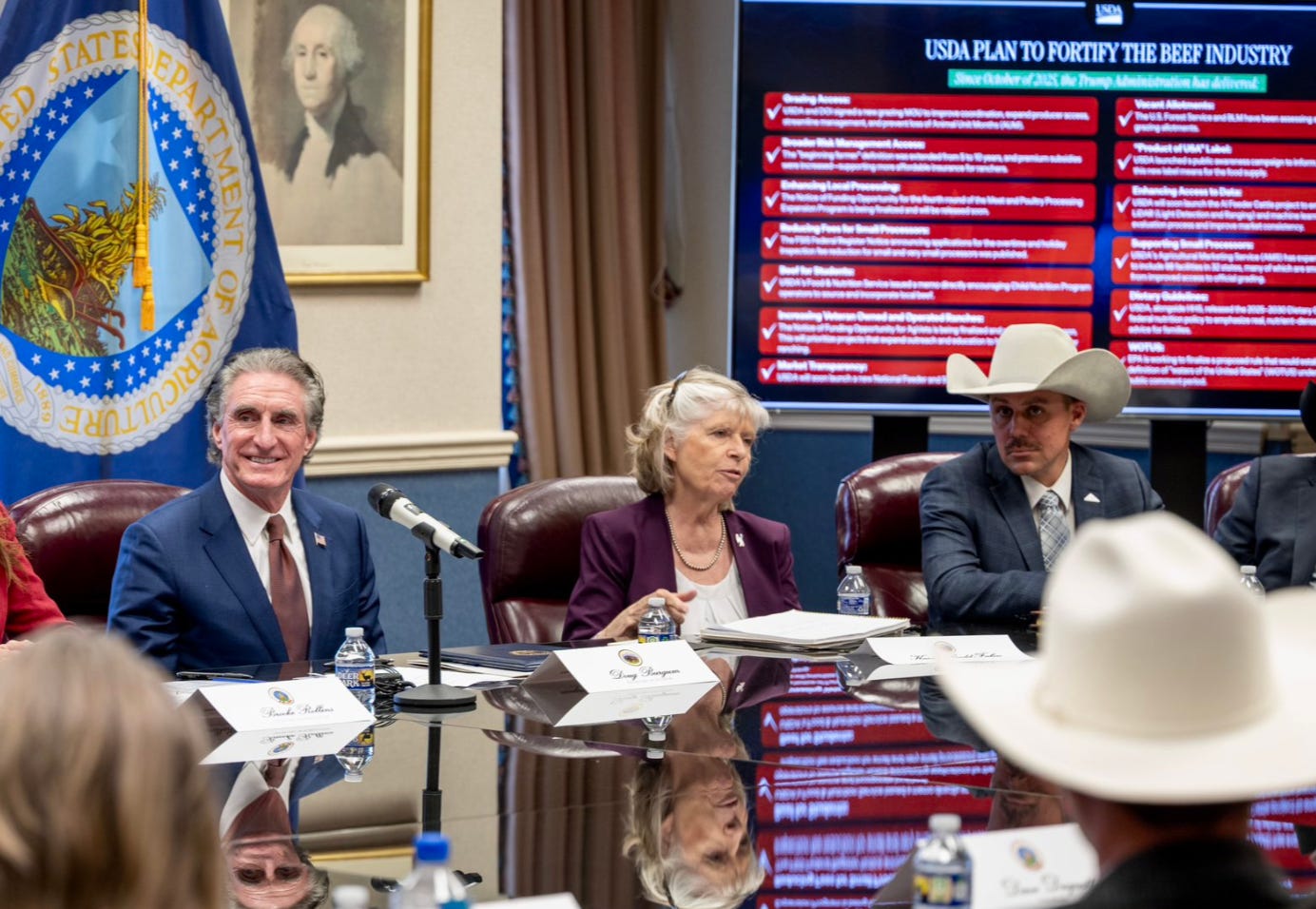
A top Interior Department official is under renewed scrutiny as growing ethics scandals engulf the powerful public lands agency.
Over the weekend, Campaign for Accountability, a government watchdog group, sent letters to the House and Senate seeking Congressional investigations into Karen Budd-Falen, the third highest-ranking official at the Interior Department and a longtime rancher and attorney. The letters, which extensively cite Public Domain’s reporting, detail what the Campaign describes as “serious and escalating ethics violations” and the Interior Department’s “apparent failure” to address them.
“The evidence now available — including on-camera statements by Ms. Budd-Falen herself, financial disclosure records, and ethics documents obtained through public records requests — establishes that she has been actively directing federal public lands policy in ways that benefit her family’s extensive ranching operation, in apparent violation of both the specific ethics commitments she made in the first Trump administration and the federal conflict of interest statute,” the letters read.
As detailed in her latest financial disclosure, Budd-Falen and her family have major financial holdings in western ranches, including permits for grazing on federal land. During her tenure at the Interior Department in Trump’s first term, she was strictly barred from working on or even discussing grazing policy given her potential conflicts of interest. But shortly after reentering the Interior Department early last year, she began working on a variety of grazing-related matters even though she and her family retained major financial stakes in ranches in Wyoming and Nevada. As Public Domain previously reported, her work on grazing-related issues has included involvement in the Interior Department’s recent overhaul of National Environmental Policy Act regulations. That overhaul stands to benefit public land ranchers across the country.
The Campaign for Accountability, in its letter, particularly highlighted a video posted on YouTube in December in which Budd-Falen described working on grazing policies that could directly benefit her family’s large ranching holdings.
“There are around 1,300 vacant allotments for the [Bureau of Land Management] right now,” Budd-Falen told Sen. Cynthia Lummis (R-Wyo.) in the video. “By the end of next year, every single vacant allotment will be filled by a rancher, who will be able to get their cattle in there grazed. We’ve added some categorical exclusions so that if you have places like in northern Nevada, where my father-in-law’s place is … We added categorical exclusions so you can move cattle in there temporarily, get some of this grass grazed off, that will also really help the wildfire situation.” What Budd-Falen didn’t mention in the video is that her father-in-law passed away several years ago, and that his long-time ranch is now owned in part by her own husband.
Budd-Falen also described grazing regulations as an issue “closest to my heart” and discussed her excitement about the Interior Department’s work to rewrite the federal regulations that govern public lands ranching in the American West.
“You want to know what put the public ranchland out of business — it was Bruce Babbitt’s regulations,” she told Lummis, referring to the Clinton-era Interior secretary. “By the first of next year, you will see fully new regulations that don’t just fix a few of the Babbitt things — we went back to the Ronald Reagan years and are putting back in those regs.”
The Interior Department is releasing its proposed revisions to federal grazing regulations this week. The Washington Post was the first to report on the YouTube video.
On March 11, amid questions from this outlet over her involvement in grazing policy, the Interior Department’s ethics office granted Budd-Falen a partial waiver that provided her wide latitude to work on grazing issues, despite her large ranch holdings. Since issuing the waiver, Interior has openly touted Budd-Falen’s work in the grazing space. The ethics waiver, however, does not appear to retroactively cover her participation in grazing issues during the first year of her current tenure. The waiver does not appear to have been in effect, for example, when Budd-Falen spoke with Sen. Lummis in December.
Delaney Marsco, director of ethics at Campaign Legal Center, a watchdog organization, wrote in an email to Public Domain that “the major red flag” with the waiver is that “while Budd-Falen had a very broad recusal in the first Trump administration, when her role was more narrow and unlikely to touch matters related to her financial interest, she is now allowed to participate in specific policy matters affecting her financial interests when she is in a more senior role with decision-making powers related to those interests.”
“The waiver acknowledges that the issues related to grazing require hyper-specific knowledge precisely because they impact a niche area of law and a very limited class of landowners, of which Budd-Falen is a member,” Marsco wrote. “These factors seem to make recusal or sale of the financial interest even more, not less, critical, because of the high chance Budd-Falen’s actions in these matters could affect her own bottom line. At the very least, her participation in grazing matters would raise the appearance of a conflict of interest and could impact the public’s trust in the work of the Interior Department.”
The Campaign for Accountability, in its letter, condemned the ethics waiver that Budd-Falen was granted in March. It called on the House and Senate to investigate whether ethics officials at the Interior Department had failed to prevent or address ethics violations.
In an email statement, an Interior spokesperson said Budd-Falen “has complied, and continues to comply, with any and all legal requirements, ethical standards and ethics guidelines.” The statement said Public Domain’s reporting attempted to “smear a successful woman who is passionate about her work.” Frank Falen, Budd-Falen’s husband, did not respond to a request for comment.
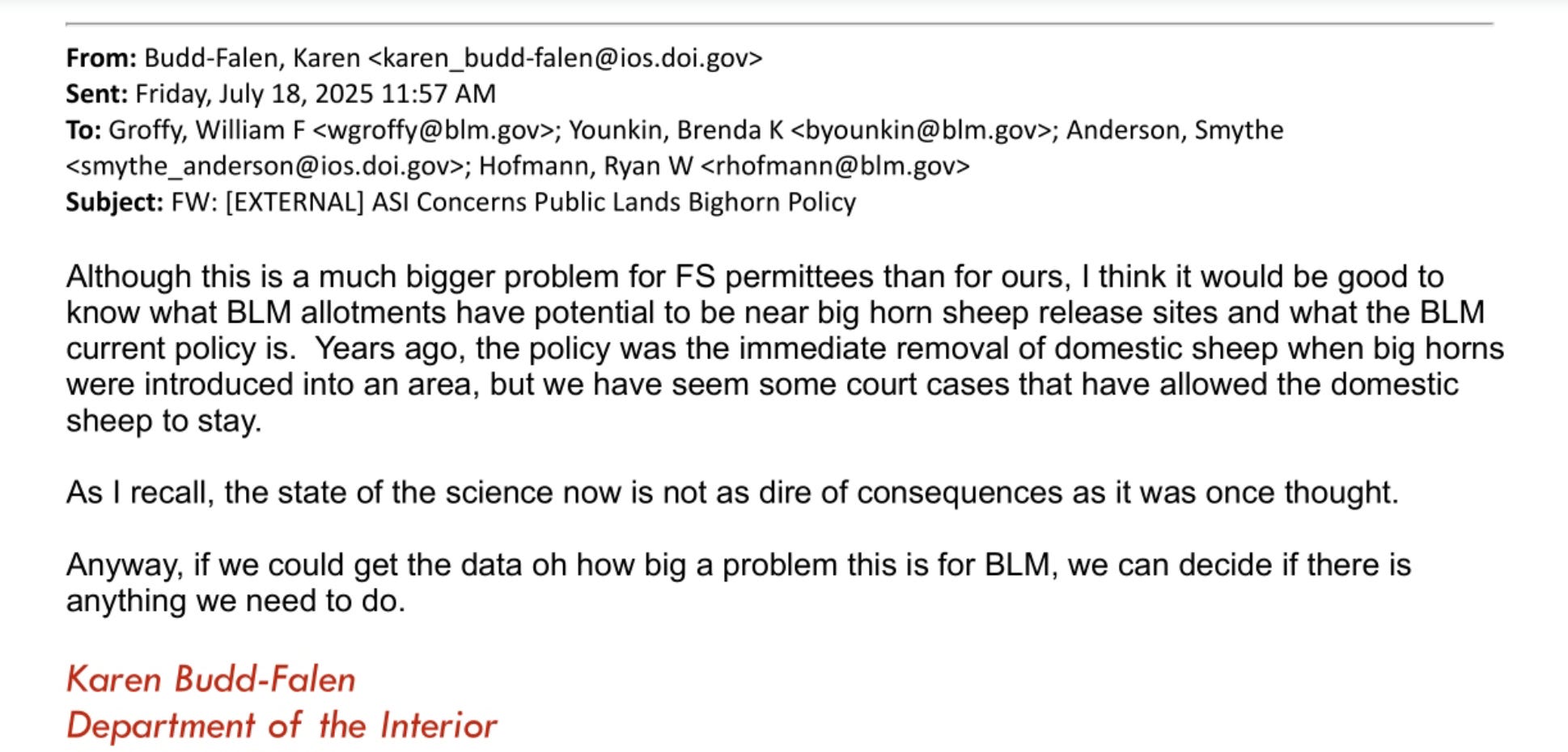
Public Domain recently obtained further proof of Budd-Falen’s involvement in grazing-related matters. Emails from July 2025 between Budd-Falen and Bureau of Land Management officials show her weighing in on policy changes sought by the American Sheep Industry Association, a trade industry group that represents sheep producers, including producers that use federal lands for grazing. Public Domain obtained the emails from a FOIA request.
All this comes atop the scandal surrounding Budd-Falen’s financial ties to the Thacker Pass lithium mine in Nevada. As Public Domain first reported, Budd-Falen’s husband struck a deal to sell water rights from one of the family ranches to Lithium Nevada, the company behind the controversial mine, shortly after Budd-Falen joined Interior during the first Trump administration. Budd-Falen repeatedly failed to disclose the deal in her required financial disclosures, and the recent waiver giving her permission to work on grazing policy notably makes no mention of it. The New York Times later reported that the Budd-Falen family ranch sold the water right for $3.5 million. Congressional Democrats asked the Interior Department’s inspector general to investigate Budd-Falen over her family’s ties to the lithium mine.
Aaron Weiss, director of the Center for Western Priorities, said you’d have to go back to the Teapot Dome scandal of the 1920s, which involved the Interior Department issuing secret oil leases in Wyoming, to find such an egregious level of self-dealing.
“A $3 million water rights deal with a lithium mine wasn’t enough the first time around, so she went back to re-write grazing regulations that benefit her personally,” said Weiss in a statement about Budd-Falen. “This stuff makes [former Interior secretary] Ryan Zinke’s quest for a brewpub look quaint.”
In a post to X over the weekend, Sen. Richard Blumenthal (Conn.), the ranking Democrat on the Senate Permanent Subcommittee on Investigation, called Budd-Falen’s recent actions on grazing policy “brazen” and said the situation “cries out for investigation.”
This story was supported by a grant from The Fund for Investigative Journalism.
Thank you for sharing this story. I helped lead the resistance to the Thacker Pass mine between 2021 and 2023, and we knew throughout that there was corruption and double-dealing happening behind the scenes. We never had proof, but so many things didn't pass the sniff test. I firmly believe that there is far more corruption around that mine that has never been reported on, and that's going beyond the "legal" corruption I wrote about here: https://maxwilbert.substack.com/p/american-greed-a-corrupt-corporation
The amount of corruption and conflicts of interest within the administration is hard to keep up with. The public is being ripped off!!
Budd-Falen weilds the Categorical Exclusion, taking lessons from the BLM. On one hand, they claim that if wild horse populations aren’t reduced, the animals will starve. On the other hand, we need to get cattle in there to graze it down. Of course, this benefits her and other cattle interests, the ones running the BLM. Who hires these people? Do they all have to have a conflict of interest and an A+ grade for lying?
The email to the sheep grazing folks illuminates the common problem with the BLM “finding the data” to support their agenda. “Scientific research” can and does accomplish this, when the BLM pays for the “research”. A 2025-2026 “study” might just show that the problem isn’t that big.
The problems on public lands, including the so-called declines in game populations, steer the eye away from the massive number of livestock, grazing down the grass, and towards the mythical “overpopulation of wild horses”. The hunters are going to be so upset when after the “feral” horses are gone, nothing changes.
The people who have been in charge of the BLM, the DOI and other public lands agencies, have had conflicts of interest for past administrations as well. Perhaps not as bad as this. If you aren't a rancher, an oil guy, or a logger, or a mining dude, you don’t get the nomination.
A minority of the population is actively ripping off the American public and getting away with it. When they are finished enriching themselves off our public resources, there will be nothing left for the rest of us. They have their foot on the gas, full throttle, and we'd better get someone in there to slam on the brakes, before they ruin everything.