


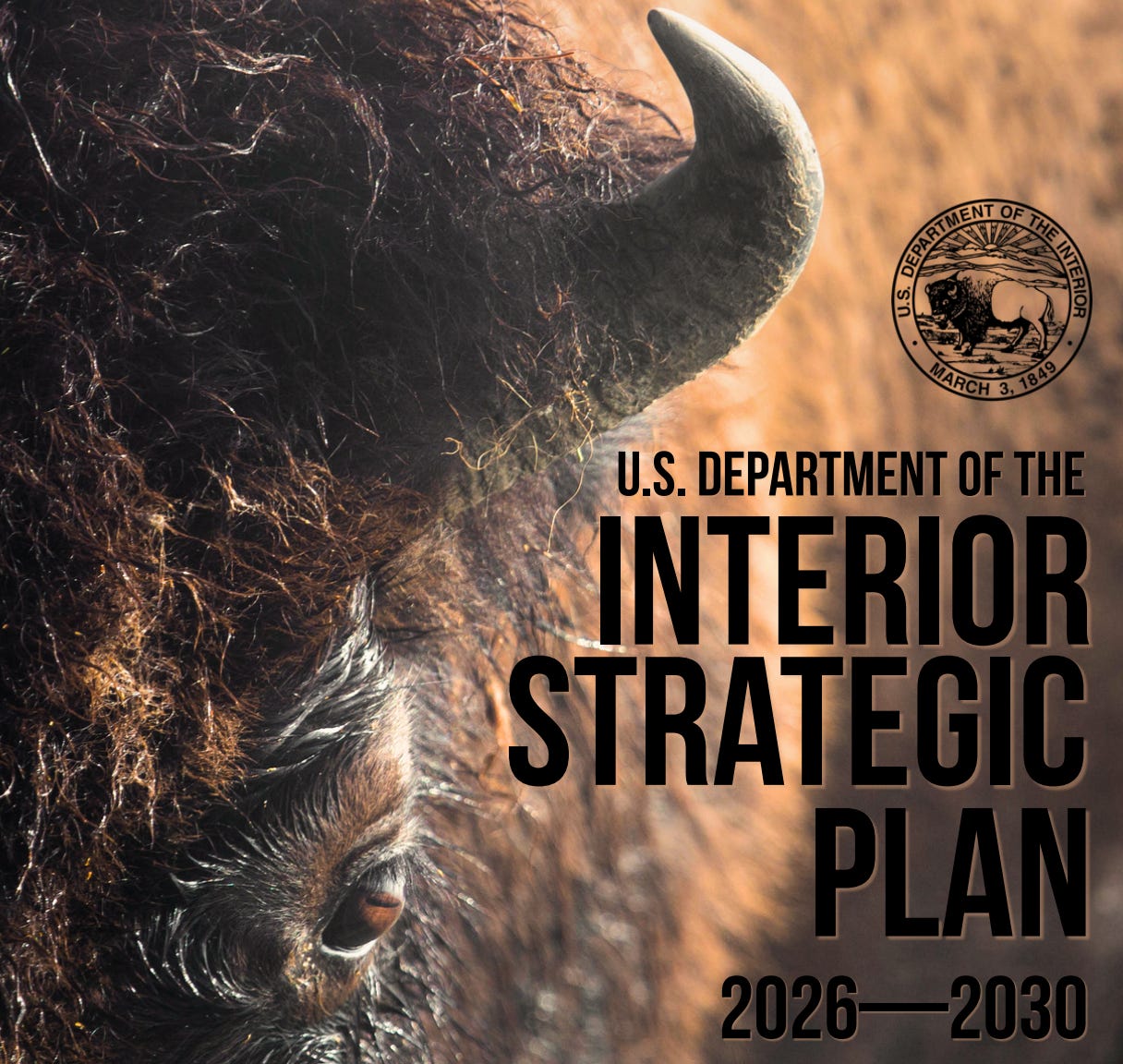
The Department of Interior will work to shrink the federal land base over the next four years, according to a strategic plan published Tuesday — marking a seismic shift for an agency charged with managing more than 500 million acres of public land.
Selling off federal public land is wildly unpopular in the American west, where most acreage is located. Republican-led efforts to sell as many as 3.2 million public acres as they crafted President Donald Trump’s “big, beautiful” spending bill last year drew a fierce backlash from public land users, including conservative-leaning hunters and anglers.
But the Trump administration has re-embraced the lightning-rod issue, just a week after voters delivered stinging defeats to Republicans across the country.
Interior envisions selling federal land primarily to states and localities. State transfers are a longstanding goal of many western conservatives that critics view as a first step on the path toward privatization.
“The Department will work to decrease the size of the federal estate by offering to states, localities and Tribes the opportunity to purchase federal lands,” the four-year strategic plan reads. “Through these sales, the Department will be able to focus its resources on primary federal responsibilities and nationally significant federal lands.”
The document, which Interior quietly posted to its website, was first reported by journalist Wes Siler.
Interior laid out its sweeping plans at a pivotal moment for public lands. Congress is currently debating a massive bill that would streamline the permitting process for energy projects on federal land, while weakening protections contained in major environmental laws.
“This is the first time ever the Department of the Interior has made selling off and giving away public lands an official goal,” Michael Carroll, a campaign director at the Wilderness Society, wrote in a message to Public Domain. “According to the law (Federal Land Policy Management Act) these lands are supposed to be retained in public ownership.”
“While the plan may be unprecedented and a terrible idea, it fits perfectly with the administration’s push to pass the permitting bill, which will enable reckless drilling, mining and data center development on our public lands at the expense of future generations,” he added.
The Interior Department did not respond to Public Domain’s request for comment.
In the 28-page document, Interior Secretary Doug Burgum and his team paint America’s public lands as resource-rich assets to be exploited for economic growth. Much of the plan’s emphasis on reducing federal land holdings relates specifically to boosting energy, mining and other extractive development.
“Interior will pursue strategic rights-of-way agreements, land exchanges and direct transfer of lands in support of reliable energy production and transport,” the plan reads. It also notes that “consolidation of land parcels, land swaps, exchanges and negotiation for rights-of-way will simplify mixed-use land management for mineral development, grazing, timber production and agriculture.”
Interior’s plan “goes well beyond the right-wing Heritage Foundation’s Project 2025 by recommending public land selloffs, which is shocking, given how incredibly unpopular this idea is,” according to Kate Groetzinger, communications director at the Center for Western Priorities.
“This plan makes it clear Burgum will continue offering our public lands up to oil CEOs and tech companies on a silver platter,” she wrote in an email. “This is exactly the opposite of what Western voters want. Passing the Senate permitting bill right now would give this administration nearly unfettered ability to enact Burgum’s agenda.”
Interior’s plan also says it “will consolidate its workforce to advance operational efficiencies” — terminology that could imply layoffs.
The Interior Department already shed some 17 percent of its workforce over Trump’s first year in office, according to an analysis by Inside Climate News. The loss of those 11,000 employees resulted from cuts imposed by the short-lived Department of Government Efficiency and turmoil resulting from Burgum’s department-wide personnel reorganization.
The plan does not mention construction of data centers on federal public land, which has emerged as a contentious issue in the last year.
But Burgum — who favors data center siting on federal land and is heavily invested himself in the artificial intelligence industry, according to a recent report from ProPublica — highlighted the potential of AI in his letter introducing the plan.
“For the first time in human history, we can turn electricity into intelligence,” Burgum wrote in a bolded sentence. “Every team member must learn quickly to harness technology to power efficiency — to find innovative ways using intelligent technologies to deliver world-class citizen services.”
Trump’s Interior Department has spent the last two years eyeing ways to privatize federal public lands, only to back away from its own agenda in the face of public backlash.
Public Domain was the first to report a draft of Interior’s strategic plan last year, which read largely like a wishlist for industry — prioritizing energy development, grazing and timber sales, while aiming to streamline provisions of bedrock conservation laws like the National Environmental Policy Act. It also outlined a roadmap for privatizing parts of America’s shared landscapes, calling for “strategic land swaps and exchanges” and the “release” of federal holdings to allow states to build housing.
At the time, Interior dismissed Public Domain’s reporting as “irresponsible,” noting that the document was in the “draft/deliberative process” and not ready for public release. When the agency finally released the public version of the draft in June 2025, much of the most controversial language, including that about reducing federal land holdings, had been removed.
Days later, U.S. Sen. Mike Lee (R-Utah) introduced his now infamous proposal to force the sale of up to 3.2 million acres of federal land in 11 western states — pitching it as a common-sense solution to America’s housing crunch. As public outrage to Lee’s effort ballooned, Burgum tried to distance the Trump administration from it, telling Scripps News in late June that “it doesn’t matter to me at all if it’s part of this [budget] bill because that wasn’t part of the president’s agenda to be part of the bill in the first place.”
As Public Domain would later report, however, the Interior Department shared research with Lee’s committee and helped craft talking points that the notoriously anti-federal-land senator from Utah used to pitch his controversial public land sell-off scheme. And months before Lee unveiled his failed proposal, the Departments of the Interior and Housing and Urban Development launched a joint task force to study selling off as many as 400,000 acres of federal land for housing development.
Trump officials have said little about that administrative effort since Lee was forced to pull the plug on his sell-off proposal.
But with midterm elections now in the rearview mirror and Trump becoming a lame duck, his administration appears much more comfortable leaning into an anti-federal land agenda.
The front and back pages of Interior’s new strategic report feature pictures of bison — a species that was driven nearly to extinction and that Trump’s Interior Department has tried, and so far failed, to evict from federal public lands in Montana.
Disclosure: The Wilderness Society has been a financial supporter of Public Domain, which earns its money through a combination of grants and reader support. Financial supporters play no role in our editorial decisions. See a list of our funders here.
I don’t recall giving that fuck permission
Offload?! Fuck them all for selling America to private assholes who want more and more money. Sinful, amoral, despicable.