


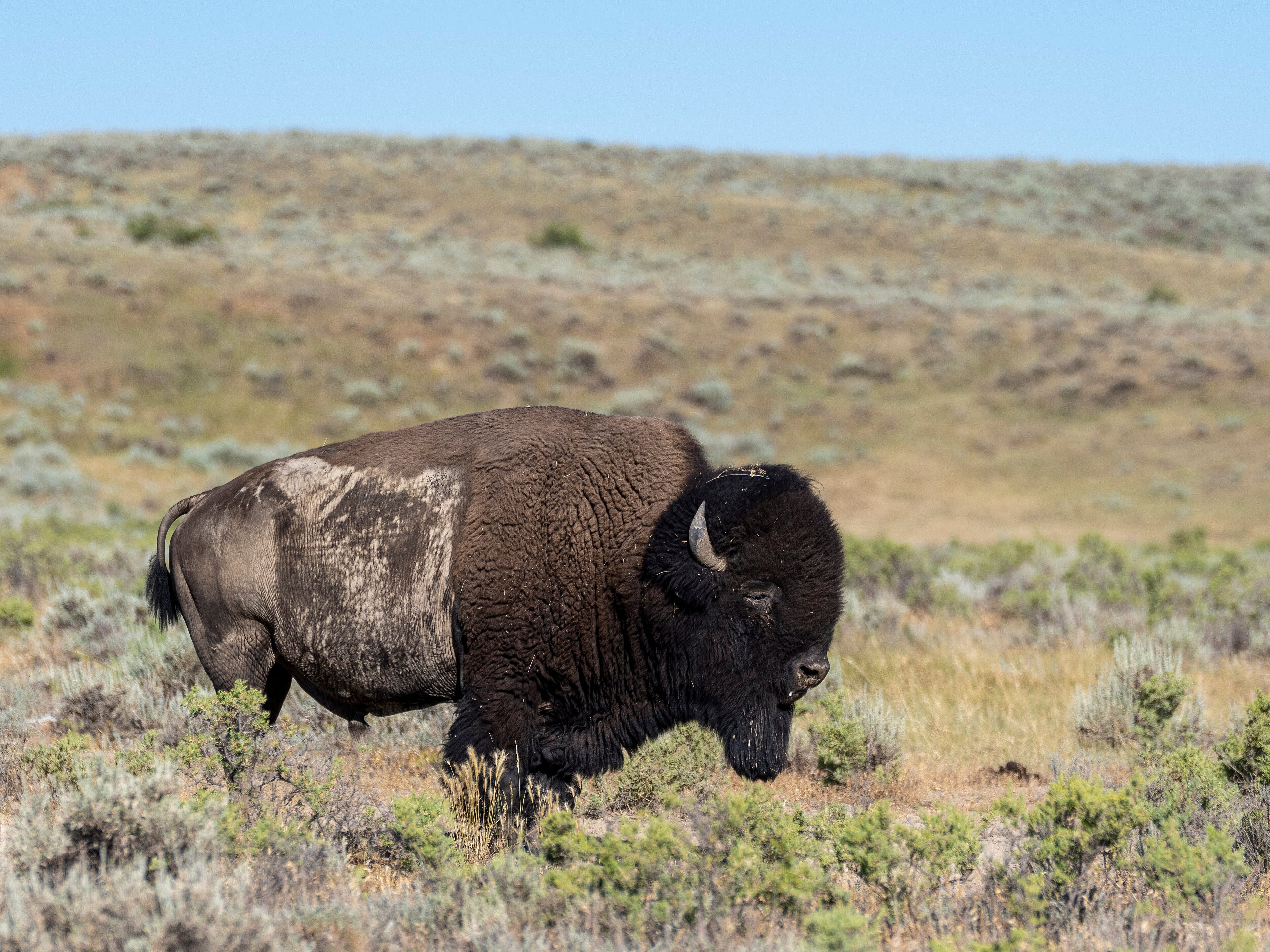
Conservation groups have filed at least three separate appeals seeking to halt the Trump administration’s decision to evict more than 900 bison from large swaths of federal land in central Montana.
The administration’s decision in early May to rescind American Prairie’s bison grazing permits marked a victory for ranching groups who see the iconic native mammal as a threat to their livestock operations and way of life. Among those who advocated to remove the bison was the Montana Stockgrowers Association, a former legal client of Karen Budd-Falen, the third highest-ranking official at the Interior Department, which oversees grazing across millions of acres of federal public land.
Late last week, American Prairie, a conservation nonprofit that is working to restore bison to thousands of acres of private and public lands in the state, appealed the Bureau of Land Management’s decision to revoke the nonprofit’s permits to graze the animals on at least six different federal allotments near Malta, Montana.
BLM justified the decision to cancel American Prairie’s grazing leases on the grounds that its buffalo are wildlife that do not qualify as “production-oriented” domestic livestock.
But neither federal laws like the Taylor Grazing Act nor agency rules impose that requirement, American Prairie argued in its appeal. Such a sweeping change would require BLM to go through the much longer and more tedious rule-making process mandated by the Administrative Procedure Act.
Even so, American Prairie contends that its bison herd does qualify as production-oriented livestock. The organization contributes animals to tribal food sovereignty programs and runs a public hunting program that has produced an estimated 75,000 pounds of meat, according to the appeal.
American Prairie received its first grazing permit for bison more than two decades ago.


Western Watersheds Project, a conservation group and vociferous critic of the cattle industry, followed up with its own appeal on Monday. The group argues that BLM’s new grazing requirement amounts to illegal rule-making. BLM’s change also should have triggered a National Environmental Policy Act analysis, the appeal says.
Both filings ask the Interior Department’s Office of Hearings and Appeals to stop the Trump administration from canceling the grazing leases until their appeals are adjudicated. Defenders of Wildlife also filed an appeal last week challenging the Trump administration’s bison policy. Together, the appeals are the first step in what could become a prolonged legal battle.
The BLM was “confident in the legal and factual basis for its decision,” a spokesperson wrote in an email to Public Domain.
“While we do not comment on pending litigation, the Bureau of Land Management’s decision was firmly grounded in federal law and a thorough review of the administrative record,” the spokesperson wrote. “The agency determined that American Prairie’s bison operation does not satisfy the statutory requirements for a federal grazing permit under the Taylor Grazing Act because the herd is managed primarily for conservation purposes rather than livestock production.”
In its press release Monday, Western Watersheds cited Public Domain’s recent reporting detailing how Budd-Falen, as a private attorney, challenged BLM’s 2022 decision allowing American Prairie to continue grazing bison. The self-proclaimed “cowboy lawyer” represented three pro-ranching entities in the case — the Montana Stockgrowers Association and the North and South Phillips County Cooperative State Grazing Districts. She argued that allowing bison to graze public lands violated multiple laws and regulations, including the Taylor Grazing Act of 1934, and caused “significant harm” to her clients.
“The political origins of this reversal are clear,” Western Watersheds wrote in its release. “As reported by Public Domain, the 2022 bison grazing decision was appealed by ranching groups represented by Karen Budd-Falen—now one of the highest-ranking officials at the Interior Department. Further, Secretary Burgum personally intervened to direct BLM to reconsider, ultimately producing the outcome Budd-Falen’s former clients sought.”
One of the grazing allotments affected by BLM’s recent reversal is the Flat Creek allotment in Montana. In her most recent financial disclosure, Budd-Falen lists the “Flat Creek Allotment” in Malta, Montana, as one of her former legal clients, Public Domain previously reported.
“Karen Budd-Falen has followed all ethical guidelines and recused herself from all matters involving her former clients,” a spokesperson for the Interior Department said in a previous statement to Public Domain concerning the bison eviction.
The battle over the grazing permits in central Montana has torched a rare opportunity for the American public to hunt buffalo.
American Prairie “had to make the difficult decision to cancel this year’s public bison harvest due to these efforts by state and federal officials to remove bison from public lands grazing,” the group’s Public Affairs Director Beth Saboe wrote in an email to Public Domain.
The organization had planned to issue 17 permits this year, according to its website.
Somewhere between 30 million and 60 million wild buffalo roamed North America when European colonization began. Around half a million remain, with livestock accounting for the vast majority of them.
Budd-Falen, herself a lifelong rancher, has become embroiled in scandal since re-entering the Trump administration, including facing mounting scrutiny over her work on grazing policy — an issue she was prohibited from working on or discussing during the first Trump administration. In March, the Interior Department’s ethics office issued Budd-Falen a sudden waiver that gave her wide latitude to work on grazing, despite potential conflicts of interest, as Public Domain first reported.
Months before receiving the waiver, however, Budd-Falen was openly talking about the Trump administration’s forthcoming rewrite of federal regulations that govern public lands ranching across the American West. In a December interview with Sen. Cynthia Lummis (R-Wyo.), Budd-Falen described grazing regulations as an issue “closest to my heart” and boasted that “we went back to the Ronald Reagan years and are putting back in those regs.”
Last month, the BLM incorporated the “production-oriented” qualification used to revoke American Prairie’s bison permits into new proposed grazing rules published in the Federal Register. In addition to thwarting American Prairie’s operations, the new rules could eliminate tribal bison grazing on federal public lands, Inside Climate News reported.
Note: This story was updated to include reference to the appeal filed by Defenders of Wildlife.
This is a wild topic at the moment. I myself have written a few articles on the topic. Is truly mind numbing But this is even a topic to be discussed.
Thank you advocates. Contribute as you are able