


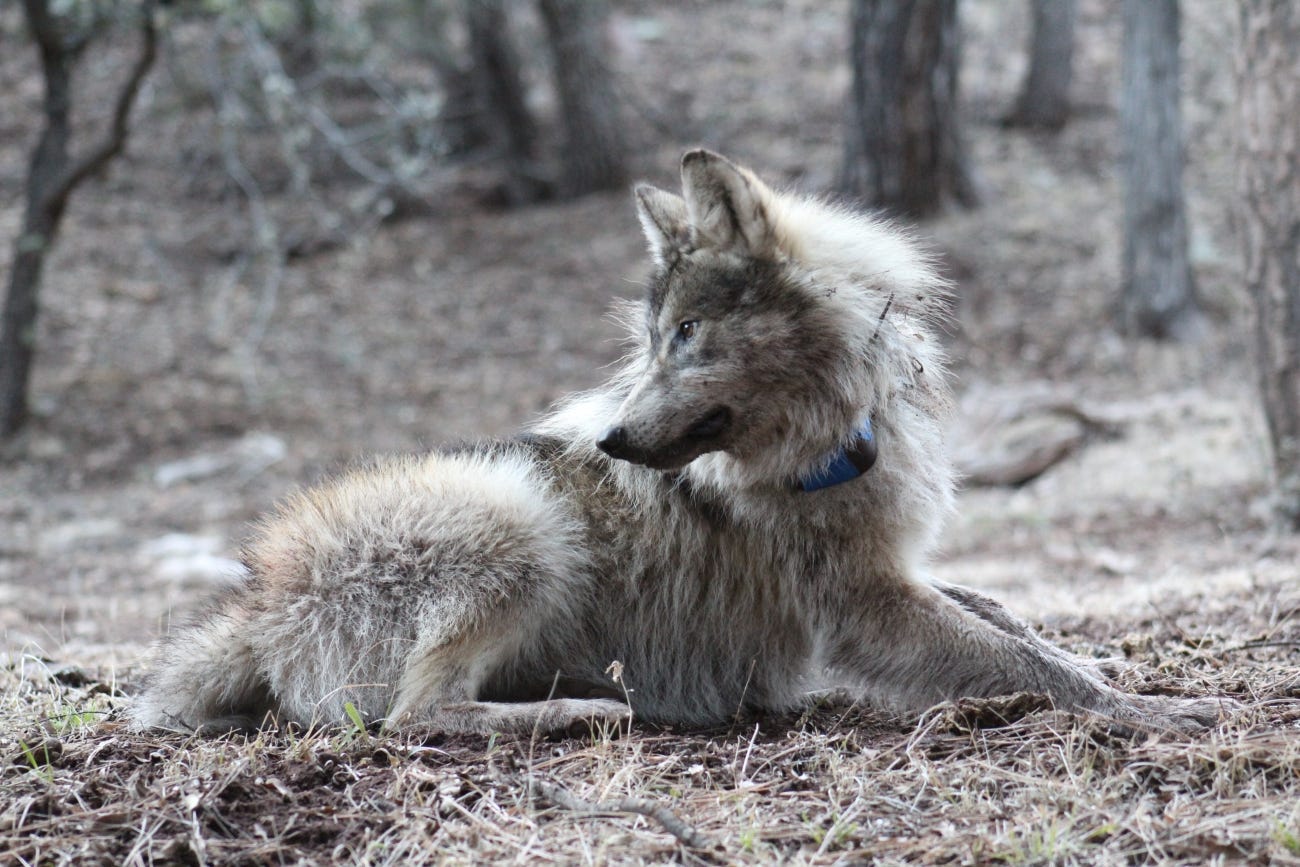
A scandal-plagued top official at the Interior Department met with former legal clients from the ranching industry before personally intervening to halt a release of endangered Mexican gray wolves last year, according to records reviewed by Public Domain.
The records provide perhaps the most concrete example of Karen Budd-Falen’s involvement in grazing-related policy before she received a controversial ethics waiver in March 2026 that gave her wide latitude to work on grazing issues. Budd-Falen, who built her legal career defending the interests of western ranchers and currently serves as the No. 3 official at the Interior Department, was barred from even discussing grazing matters when she served in a high-ranking role during the first Trump administration. But in the second Trump term, she appears to be working in an official capacity on issues linked to her past employment as a private attorney, rancher and grazing advocate.
In mid June last year, the U.S. Fish and Wildlife Service was preparing to transfer the Mexican wolf Asha and her pack onto a ranch owned by the billionaire Ted Turner in southwest New Mexico, with the goal of releasing them into the wild by early July. But just days before the scheduled transfer, FWS staff received a terse email from Budd-Falen, a top deputy to Interior Secretary Doug Burgum and a long-time conservative lawyer and rancher.
“After the big meeting we had, I just found out that the FWS is going to move Mexican wolves onto the Ted Turner ranch days before the Secretary goes to New Mexico for Western Governor’s Association meeting ------ and we want to issue a press release?” Budd-Falen wrote in a June 20 2025 email, which was first obtained and reported on by the Santa Fe New Mexican. “Those wolves will not stay on Ted Turner’s ranch.”
“Thanks Karen, we apologize for the short notice,” replied Paul Souza, a regional FWS director. “This will not happen next week and we don’t have a rescheduled date. We have many details to think through and dots to connect, as you suggest.”
By the afternoon of June 20, Brady McGee, FWS’s coordinator for the Mexican wolf recovery program, emailed his colleagues to apologize for the aborted wolf release plan.
“I am sorry for the short notice and for what is happening,” McGee wrote. “We are not transferring wolves to Ladder Ranch next week…”
“Again,” he added, “sorry for this mess, but it’s coming from the top 2 people in the Secretary’s office.”
In halting the original plan to release Asha and her pack onto Turner’s ranch, the FWS failed to meet a significant self-imposed deadline. “It is important this action happen in June – July,” agency officials stated in an internal document. “This maximizes the chances that wolf with a mate and dependent pups will stay localized the pups will remain too young to disperse. Also, this timing corresponds with elk calving (~June 5) to facilitate natural hunting behavior.” Ultimately, Asha, also known as F2754, and her pack were released into the wild, but not until early August 2025, missing the June-July window favored by agency staff.
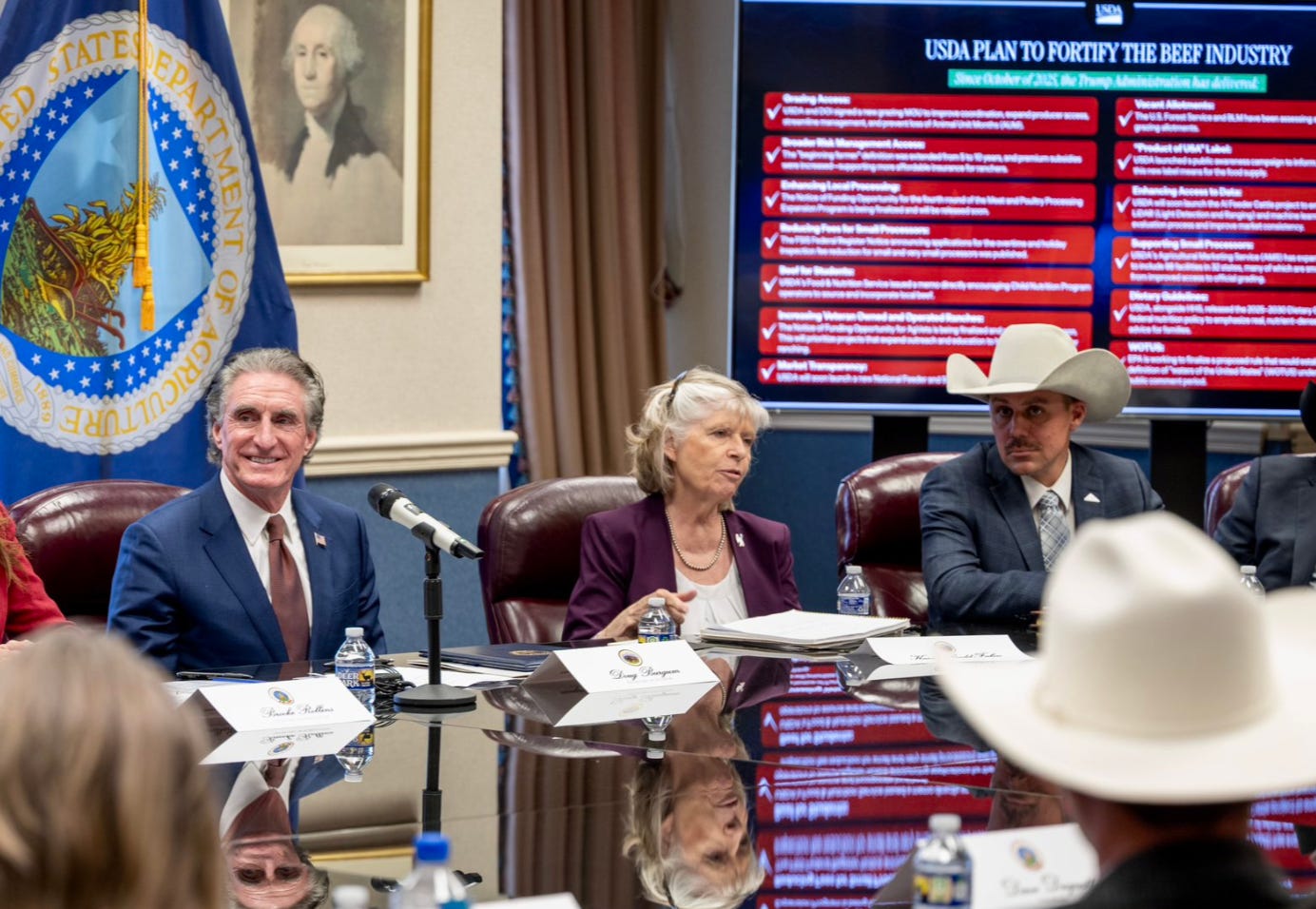
Budd-Falen’s role in blocking the June plan to transfer and release the wolf pack came a few weeks after she personally attended a meeting on Mexican wolf issues with officials from the New Mexico Cattle Growers’ Association, or NMCGA, an organization of ranchers that has long criticized the federal wolf recovery program. The meeting, which took place on June 3 in Ruidoso, New Mexico, also included FWS staff, a range of ranching interests, and a large group of county commissioners from Arizona and New Mexico. This was the “big meeting” Budd-Falen referred to in her email to FWS staff.
A Public Domain analysis of public records reveals that some of the attendees at that Ruidoso wolf meeting were former legal clients of Budd-Falen, raising fresh questions about her ethical conduct since rejoining the Trump administration. The Interior Department did not respond to Public Domain’s specific questions, but sent a lengthy statement defending Budd-Falen as a “highly qualified, principled public servant” who has “followed all ethical guidelines.”
Interior’s statement was nearly identical to one the agency sent when Public Domain reached out for a separate story in May, with one notable exception: the May statement included a line about Budd-Falen having “recused herself from all matters involving her former clients.” Asked about the dropped language, an Interior spokesperson said Public Domain “could use either version” of the statement.
In 2021, Budd-Falen filed a legal petition against the Interior Department — the agency she now helps lead — arguing that officials violated federal law when they finalized a decision to translocate what she described as “known problem” Mexican wolves onto Turner’s Ladder Ranch, the very same property at the center of last June’s shelved wolf release. In that legal fight, Budd-Falen represented Sierra County commissioners and three nearby ranches.
Travis Day, the then-chairman of the Sierra County Commission, was named as a participant in the Ruidoso wolf meeting last year, according to emails. Day, who did not respond to Public Domain’s request for comment, has since left the commission to serve in the Trump administration, as USDA’s state director for rural development in New Mexico. Current Sierra County Commissioner Jim Paxon told the Sante Fe New Mexican that he protested last year’s planned wolf release on Ladder Ranch and downplayed the Trump administration’s intervention as “cursory.”
“They acknowledged our protest, ran it through their legal department, released the wolves,” Paxon told the publication. “That’s about how that went.”
Other participants at the Ruidoso wolf meeting were former Budd-Falen clients as well. In 2022, Budd-Falen represented the New Mexico Cattle Growers’ Association in a complaint the group filed challenging a U.S. Forest Service’s proposal to cull feral cows on national forest land. And more recently, in 2024, she represented the New Mexico Federal Lands Council, a frequent critic of federal conservation policy, in an amicus brief filed with the Supreme Court in support of Utah’s efforts to seize control of millions of acres of federal land within its borders.
The Secretary Treasurer of the New Mexico Federal Lands Council is a prominent ranching advocate named Caren Cowan, according to the group’s website. Cowan was named as a participant in the Ruidoso wolf meeting in an email that Tom Paterson, then the NMCGA President-elect, sent on June 16 last year.
Paterson, in a statement to Public Domain, said the Ruidoso meeting was “not an NMCGA meeting. It was a meeting organized by individuals concerned about the increasingly negative impact of Mexican wolves on public safety, economic livelihoods and other species in southwestern NM and southeastern AZ.”
“Ms. Cowan attended,” he added, “but my recollection is that she attended as an interested community member. She was not there representing any organization, including the New Mexico Federal Lands Council.”
News of Budd-Falen’s presence at the Ruidoso meeting alongside numerous former legal clients comes amid a swirl of ethics scandals that have surrounded her tenure at the Interior Department.
As Public Domain has extensively reported, Budd-Falen is facing calls for investigations over potential conflicts of interests stemming from her personal financial ties to the controversial Thacker Pass lithium mine and her work on grazing policies that could ultimately benefit her family’s sprawling ranching operations. More recently, Public Domain detailed how Budd-Falen represented ranching groups in challenging the Bureau of Land Management’s 2022 decision allowing American Prairie Reserve, a conservation group, to continue grazing bison on federal lands in Montana. Interior Secretary Doug Burgum, Budd-Falen’s boss, personally intervened in that case earlier this year and the BLM revoked American Prairie’s bison grazing permits last month. That decision ultimately fulfilled the very request that Budd-Falen and others made of the agency back in 2022.
The ethics waiver that Interior granted Budd-Falen in March 2026 does not appear to retroactively cover her participation in grazing issues during the first year of her current tenure, including her role in delaying last year’s release of the Mexican wolf pack.
The Ruidoso meeting in June 2025 was an opportunity for cattle interests and numerous conservative county commissioners to advocate for their priorities at the Interior Department. They brought to the meeting a list of proposals for the Fish and Wildlife Service and the Interior Department. Among other things, they proposed that FWS engage in “no more wolf releases other than to meet genetic diversity requirements.” They also proposed that the Fish and Wildlife Service “authorize lethal and non-lethal removal of wolves that invade communities,” “issue rubber bullets to anyone who wants them to use on Mexican wolves,” and provide “GPS real-time data that the FWS gets.” They requested FWS “respond to us within 30 days on these proposed solutions,” according to records obtained by Public Domain.
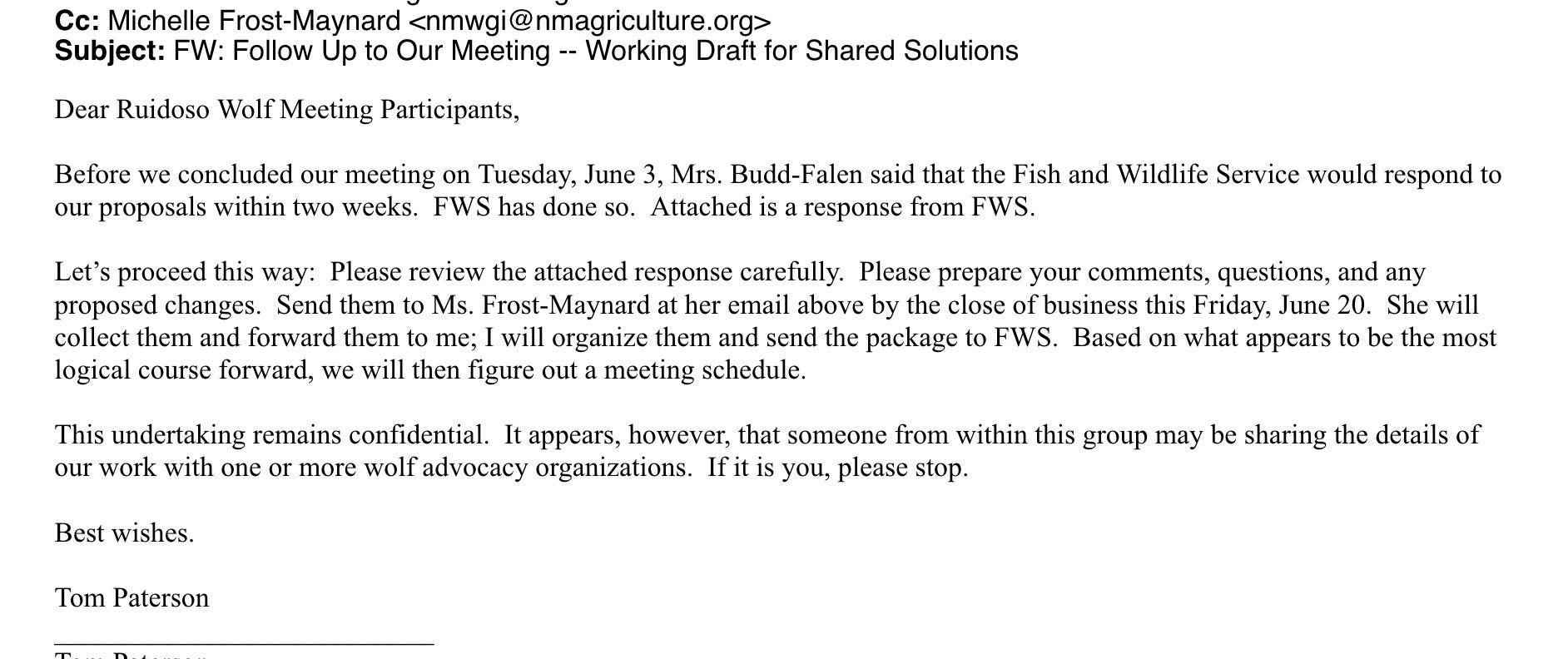
On June 16, Paterson, of NMCGA, wrote to his allies to inform them that he had received FWS’s response to his organization’s proposals. “Before we concluded our meeting on Tuesday, June 3, Mrs. Budd-Falen said that the Fish and Wildlife Service would respond to our proposals within two weeks,” he wrote in an email obtained by Public Domain. “FWS has done so. Attached is a response from FWS.”
The agency seems to have delivered on many of the proposals that NMCGA and its allies put forth. According to FWS’s response to the Ruidoso meeting participants, the agency pledged “to employ effective hazing, trapping, and translocation methods to manage wolves that habituate to populated areas. Additionally, we will provide local law enforcement with necessary resources, including less-than-lethal projectiles, to ensure that human-wolf interactions are managed appropriately and immediately. We will also permit members of the public to use less-than-lethal projectiles under our current regulations.” The agency also committed to provide more Mexican wolf location data and other concessions.
In an email to Public Domain, Paterson of NMCGA praised the government’s participation in the Ruidoso meeting. “What I do know is that, for the first time in many years, the federal government listened to rural community members about the problems associated with Mexican wolves,” he wrote.
Critics of the Trump administration’s Mexican wolf policies, meanwhile, blasted Budd-Falen’s actions in this case.
“The Mexican gray wolf program deserves better than political interference and top-down anti-wolf control,” said Greta Anderson, deputy director of Western Watersheds Project, a conservation watchdog group.
Mexican wolves have been listed as endangered under the Endangered Species Act since 1976. Budd-Falen has been a longtime critic of the ESA, once describing it as “a sword to tear down the American economy, drive up food, energy and housing costs and wear down and take out rural communities and counties.”
The ESA has been instrumental in recovering Mexican wolves. Last year, the population in Arizona and New Mexico numbered more than 300 individuals — the highest count since reintroduction efforts began in the late 1990s.
This story was supported by a grant from the Fund for Investigative Journalism.
Correction: A previous version of this story misstated the population of Mexican wolves. It has been updated.
Plagued by ethics complaints seems to be a trumpco job requirement
Ethics has been understood concerning job prospects. One should heed this lingering topic.